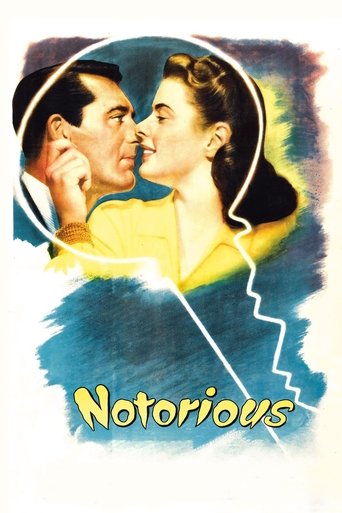
Notorious (1946)
Deep their love! Great the risk!
In order to help bring Nazis to justice, U.S. government agent T.R. Devlin recruits Alicia Huberman, the American daughter of a convicted German war criminal, as a spy. As they begin to fall for one another, Alicia is instructed to win the affections of Alexander Sebastian, a Nazi hiding out in Brazil. When Sebastian becomes serious about his relationship with Alicia, the stakes get higher, and Devlin must watch her slip further undercover.
- Date of release
- 1946-08-21
- TMDB
- 7.7 / 10 (1836)
- Runtime
- 1h 43m
- Genres
- Drama, Romance, Thriller
- Director
- Alfred Hitchcock
Casting
- Cary Grant — Devlin
- Ingrid Bergman — Alicia Huberman
- Claude Rains — Alexander Sebastian
- Louis Calhern — Paul Prescott
- Leopoldine Konstantin — Madame Sebastian
- Reinhold Schünzel — Dr. Anderson
- Moroni Olsen — Walter Beardsley
- Ivan Triesault — Eric Mathis
- Alex Minotis — Joseph
- Wally Brown — Mr. Hopkins
- Charles Mendl — Commodore
- Ricardo Costa — Dr. Barbosa
Interesting facts
- Box office: $24.5M
- Budget: $1M
- Earned 24.5× its budget
- Awards: 0 · Nominations: 2
Notorious is a 1946 American spy film noir directed and produced by Alfred Hitchcock, starring Cary Grant, Ingrid Bergman, and Claude Rains as three people whose lives become intimately entangled during an espionage operation.
Production
Notorious started life as a David O. Selznick production, but by the time it hit American screens in August 1946, it bore the RKO studio's logo. Alfred Hitchcock became the producer, but as on all his subsequent films, he limited his screen credits to "Directed by" and his possessive credit above the title.
Its first glimmer occurred some two years previously, in August 1944, over lunch between Hitchcock and Selznick's story editor, Margaret McDonell. Her memo to Selznick said that Hitchcock was "very anxious to do a story about confidence tricks on a grand scale [with] Ingrid Bergman [as] the woman ...
Dozier's interest rekindled Selznick's, which up to that point had only been tepid. Perhaps what started Hitchcock's mind rolling was "The Song of the Dragon", a short story by John Taintor Foote which had appeared as a two-part serial in the Saturday Evening Post in November 1921; Selznick, who owned the rights to it, had passed it on to Hitchcock from his unproduced story file during the filming of Spellbound.
Hitchcock travelled to England for Christmas 1944, and when he returned, he had an outline for Selznick's perusal. The producer approved development of a script, and Hitchcock decamped for Nyack, New York, for three weeks of collaboration with Ben Hecht, whom he had just worked with on Spellbound. The two would work at Hecht's house, with Hitchcock repairing at night to the St. Regis New York.
Their story conferences were idyllic. Mr. Hecht would stride about or drape himself over chair or couch, or sprawl artistically on the floor. Mr. Hitchcock, a 192-pound Buddha (reduced from 295) would sit primly on a straight-back chair, his hands clasped across his midriff, his round button eyes gleaming. They would talk from nine to six; Mr.
Read on Wikipedia · Text from Wikipedia, CC BY-SA 4.0. Data from Wikidata.
Recommended
- Casablanca 1943 · ★ 8.1
- Eye of the Needle 1981 · ★ 6.7
- Secret Agent 1936 · ★ 6.1
- The Russia House 1990 · ★ 6.1
- A Place in the Sun 1951 · ★ 7.3
- The House on Telegraph Hill 1951 · ★ 6.4
- The Bridges of Madison County 1995 · ★ 7.7
- Endless Love 2014 · ★ 6.9
- Mata Hari 1931 · ★ 6.2
- Dot the I 2003 · ★ 6.0
- Angel Eyes 2001 · ★ 6.1
- Secret Beyond the Door 1947 · ★ 6.5