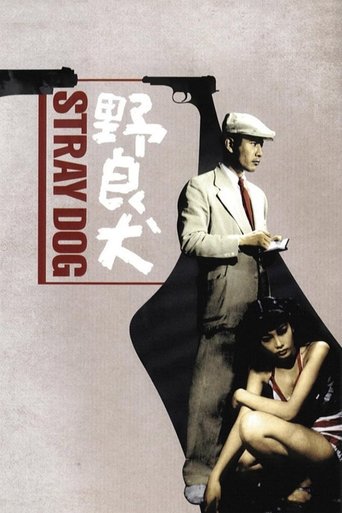
Stray Dog (1949)
野良犬
The Suspense Filled Story of 7 Bullets!
A bad day gets worse for young detective Murakami when a pickpocket steals his gun on a hot, crowded bus. Desperate to right the wrong, he goes undercover, scavenging Tokyo’s sweltering streets for the stray dog whose desperation has led him to a life of crime. With each step, cop and criminal’s lives become more intertwined and the investigation becomes an examination of Murakami’s own dark side.
- Date of release
- 1949-10-17
- TMDB
- 7.6 / 10 (387)
- Runtime
- 2h 2m
- Genres
- Crime, Drama, Thriller, Mystery
- Director
- Akira Kurosawa
Casting
- Toshirō Mifune — Det. Murakami
- Takashi Shimura — Det. Sato
- Keiko Awaji — Harumi Namiki
- Eiko Miyoshi — Harumi's mother
- Noriko Sengoku — Girl
- Noriko Honma — Wooden Tub Shop woman
- Reikichi Kawamura
- Chōko Iida — Kogetsu Hotel manager
- Eijirō Tōno
- Yasushi Nagata
- Kappei Matsumoto
- Isao Kimura — Yusa
Interesting facts
- Filmed in: Japan
Stray Dog is a 1949 Japanese crime drama noir film directed and co-written by Akira Kurosawa, starring Toshiro Mifune and Takashi Shimura. It was Kurosawa's second film of 1949 produced by the Film Art Association and released by Shintoho. It is also considered a detective movie that explores the mood of Japan during its painful postwar recovery, as well as a precursor to the contemporary police procedural and buddy cop film genres, based on its premise of pairing two cops with different personalities and motivations together on a difficult case.
Production
Stray Dog was directed by Akira Kurosawa. Kurosawa and Ryuzo Kikushima co-wrote the screenplay, and the film was co-produced by Shintoho and the Film Art Association.
Stray Dog was the first time that Kurosawa collaborated with Ryuzo Kikushima, with the former sending the latter to the Tokyo Metropolitan Police Department to collect cases that they could use as the basis for the script of the film, choosing a case where a young detective lost his pistol. It also takes inspiration from contemporary debates in Japan about the "après-guerre" generation with its apparent rise in delinquency and crime.
He mentioned in several interviews that his script was inspired by Jules Dassin’s The Naked City and the works of Georges Simenon. Kurosawa heard of a detective who had lost his pistol, and based the screenplay on an unpublished novel Kurosawa wrote around the anecdote within six weeks. He attempted to rewrite the novel as a screenplay and finished it within around two months.
Stray Dog was mostly shot at a studio rented by Toho with more than thirty sets built. Ishirō Honda, who would go on to direct several monster movies such as Godzilla and Mothra, served as Kurosawa's chief assistant, shooting second unit footage for the 10-minute long sequence of Murakami roaming through Tokyo, and often doubled for Toshiro Mifune in waist shots.
The film was also the debut of then sixteen-year old Keiko Awaji, who plays Harumi Namiki, a dancer and the girlfriend of Yusa, the villain of the film. She was chosen over other actresses because of her mean looks. Kurosawa described her as being too spoiled and that she could not cry on cue, and never cast her again in another movie of his. Awaji would later regret her unprofessionalism during filming.
Read on Wikipedia · Text from Wikipedia, CC BY-SA 4.0. Data from Wikidata.
Recommended
- High and Low 1963 · ★ 8.4
- Detective Conan: One-Eyed Flashback 2025 · ★ 7.2
- Detective Conan: Captured in Her Eyes 2000 · ★ 7.5
- Tokyo Joe 1949 · ★ 6.2
- Case Closed: The Crimson Love Letter 2017 · ★ 6.5
- The Mask of Dimitrios 1944 · ★ 7.1
- Detective Conan: The Darkest Nightmare 2016 · ★ 6.8
- Detective Conan: The Bride of Halloween 2022 · ★ 6.5
- Case Closed: The Fourteenth Target 1998 · ★ 7.2
- Detective Conan: Quarter of Silence 2011 · ★ 7.1
- Laura 1944 · ★ 7.6
- The Naked City 1948 · ★ 7.2