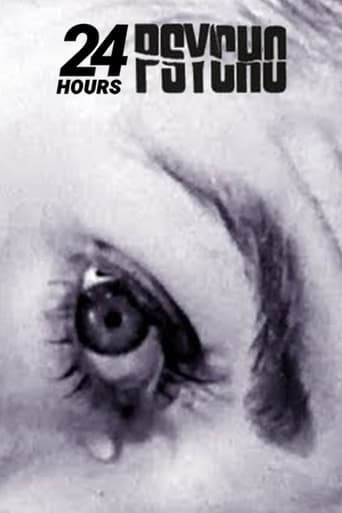
24 Hour Psycho (1993)
24 Hour Psycho is the title of an art installation created by artist Douglas Gordon in 1993. The work consists entirely of an appropriation of Alfred Hitchcock's 1960 Psycho slowed down to approximately two frames a second, rather than the usual 24. As a result it lasts for exactly 24 hours, rather than the original 109 minutes. The film was an important work in Gordon's early career, and is said to introduce themes common to his work, such as "recognition and repetition, time and memory, complicity and duplicity, authorship and authenticity, darkness and light."
- Date of release
- 1993-04-24
- TMDB
- 4.0 / 10 (2)
- Runtime
- 16h 39m
- Genres
- Thriller
- Director
- Douglas Gordon
Interesting facts
24 Hour Psycho is a 1993 art installation video by Scottish artist Douglas Gordon. It is an appropriation of Alfred Hitchcock's 1960 psychological thriller film Psycho, slowed down to approximately two frames per second from its original 24. As a result, the film lasts for precisely 24 hours, rather than the original running time of 109 minutes.
Production
Douglas Gordon is a Scottish artist known for his use of conceptual art and repetition in his work. He often uses scenes from other films to create his video art. 24 Hour Psycho was his first work to use such repetition.
Gordon didn't see Psycho until the age of 21 and rewatched the film repeatedly—including in slow motion. This, which Gordon calls an "active curiosity", inspired him to create 24 Hour Psycho. To create the film, Gordon used a VHS tape of Psycho and played it through a cassette deck that possessed the ability to slow play videos to an extreme capacity.
The Guardian writes that as Gordon's first film, 24 Hour Psycho introduced several important themes in his future work: "recognition and repetition, time and memory, complicity and duplicity, authorship and authenticity, darkness and light." Gordon regards 24 Hour Psycho not as an appropriation, but more as an "affiliation", stating that it was not simply a case of abduction.
Read on Wikipedia · Text from Wikipedia, CC BY-SA 4.0. Data from Wikidata.