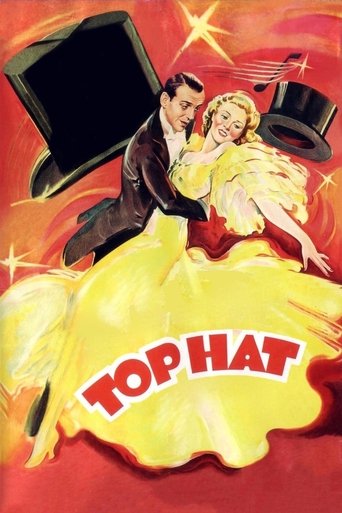
Top Hat (1935)
They're Dancing Cheek-To-Cheek Again!
Showman Jerry Travers is working for producer Horace Hardwick in London. Jerry demonstrates his new dance steps late one night in Horace's hotel room, much to the annoyance of sleeping Dale Tremont below. She goes upstairs to complain and the two are immediately attracted to each other. Complications arise when Dale mistakes Jerry for Horace.
- Date of release
- 1935-08-29
- TMDB
- 7.2 / 10 (356)
- Runtime
- 1h 39m
- Genres
- Music, Comedy, Romance
- Director
- Mark Sandrich
Casting
- Fred Astaire — Jerry Travers
- Ginger Rogers — Dale Tremont
- Edward Everett Horton — Horace Hardwick
- Erik Rhodes — Alberto Beddini
- Eric Blore — Bates
- Helen Broderick — Madge Hardwick
- Lucille Ball — Flower Shop Clerk (uncredited)
- Gino Corrado — Venice Hotel Manager (uncredited)
- Leonard Mudie — Florist (uncredited)
- Dennis O'Keefe — Elevator Passenger / Hotel Guest / Dancer (uncredited)
- Nick Thompson — Italian Police Officer (uncredited)
- Tom Ricketts — Nervous Thackeray Club Waiter (uncredited)
Interesting facts
- Budget: $609K
- Awards: 0 · Nominations: 2
Top Hat is a 1935 American musical comedy film, in which Fred Astaire plays an American tap dancer named Jerry Travers, who arrives in London to star in a show produced by Horace Hardwick. He meets and attempts to impress Dale Tremont to win her affection. The film also features Eric Blore as Hardwick's valet Bates, Erik Rhodes as Alberto Beddini, a fashion designer and rival for Dale's affections, and Helen Broderick as Hardwick's long-suffering wife Madge.
Production
Top Hat began filming on April 1, 1935, and cost $620,000 to make. Shooting ended in June and the first public previews were held in July. These led to cuts of approximately ten minutes, mainly in the last portion of the film: the carnival sequence and the gondola parade which had been filmed to show off the huge set were heavily cut.
Dwight Taylor was the principal screenwriter in this, the first screenplay written specially for Astaire and Rogers. Astaire reacted negatively to the first drafts, complaining that "it is patterned too closely after The Gay Divorcee", and "I am cast as ... a sort of objectionable young man without charm or sympathy or humour".
The Hays Office insisted on only minor changes, including probably the most quoted line of dialogue from the film: Beddini's motto "For the women the kiss, for the men the sword", which originally ran "For the men the sword, for the women the whip". Of his role in the creation of Top Hat, Taylor recalled that with Sandrich and Berlin he shared "a kind of childlike excitement.
This was composer Irving Berlin's first complete film score since 1930 and he negotiated a unique contract, retaining the copyrights to the score with a guarantee of ten percent of the profits if the film earned in excess of $1,250,000. Eight songs from the original score were discarded as they were not considered to advance the film's plot. One of these, "Get Thee Behind Me, Satan", was also used in Follow the Fleet (1936).
Astaire recalled how this success helped restore Berlin's flagging self-confidence. Astaire had never met Berlin before this film, although he had danced on stage to some of his tunes as early as 1915. There ensued a lifelong friendship with Berlin contributing to more Astaire films (six in total) than any other composer. Of his experience with Astaire in Top Hat Berlin wrote: "He's a real inspiration for a writer.
Read on Wikipedia · Text from Wikipedia, CC BY-SA 4.0. Data from Wikidata.
Recommended
- Roberta 1935 · ★ 7.1
- Royal Wedding 1951 · ★ 6.4
- Ziegfeld Follies 1945 · ★ 6.0
- Thoroughly Modern Millie 1967 · ★ 6.9
- The Wrong Paris 2025 · ★ 6.7
- The Boy Friend 1971 · ★ 6.4
- How to Marry a Millionaire 1953 · ★ 6.8
- You'll Never Get Rich 1941 · ★ 6.5
- Silk Stockings 1957 · ★ 6.8
- A Damsel in Distress 1937 · ★ 6.6
- Brigadoon 1954 · ★ 6.5
- Only You 1994 · ★ 6.7