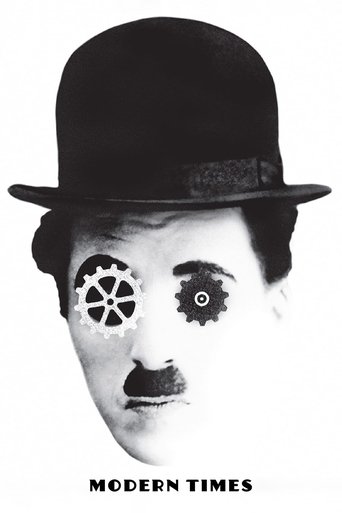
Modern Times (1936)
He stands alone as the greatest entertainer of modern times! No one on earth can make you laugh as heartily or touch your heart as deeply...the whole world laughs, cries and thrills to his priceless genius!
A bumbling tramp desires to build a home with a young woman, yet is thwarted time and time again by his lack of experience and habit of being in the wrong place at the wrong time...
- Date of release
- 1936-02-05
- TMDB
- 8.3 / 10 (4256)
- Runtime
- 1h 27m
- Genres
- Comedy, Drama, Romance
- Director
- Charlie Chaplin
Casting
- Charlie Chaplin — The Tramp (A Factory Worker)
- Paulette Goddard — A Gamin
- Henry Bergman — Cafe Proprietor
- Tiny Sandford — Big Bill
- Chester Conklin — Mechanic
- Hank Mann — Burglar
- Stanley Blystone — Gamin's Father
- Al Ernest Garcia — President of the Electro Steel Corp.
- Richard Alexander — Prison Cellmate
- Cecil Reynolds — Minister
- Mira McKinney — Minister's Wife
- Murdock MacQuarrie — J. Widdecombe Billows
Interesting facts
- Box office: $1.4M
- Budget: $1.5M
- Earned 0.9× its budget
- Filmed in: Long Beach
- Awards: 1 · Nominations: 0. Including: National Board of Review: Top Ten Films
Modern Times is a 1936 American part-talkie satirical slapstick comedy film produced, scored, co-edited, written and directed by Charlie Chaplin. In Chaplin's last performance as the iconic Little Tramp, his character struggles to survive in the modern, industrialized world. The film also stars Paulette Goddard, Henry Bergman, Tiny Sandford and Chester Conklin.
Production
During a European tour promoting City Lights, Chaplin got the inspiration for Modern Times from both the lamentable conditions of the continent through the Great Depression, along with a conversation with Mahatma Gandhi in which they discussed modern technology. Chaplin did not understand why Gandhi generally opposed it, though he granted that "machinery with only consideration of profit" had put people out of work and ruined lives.
Chaplin began preparing the film in 1934 as his first "talkie", and went as far as writing a dialogue script and experimenting with some sound scenes. However, he soon abandoned these attempts and reverted to a silent format with synchronized sound effects and sparse dialogue.
Chaplin biographer Jeffrey Vance has noted: “Chaplin recognized that Modern Times was the valedictory for the Tramp and deliberately included many gags and sequences as a loving farewell to the character and an homage to the visual comedy tradition."
This film also famously uses matte painting in the harrowing skating scene where the Tramp skates blindfolded, not realizing he is constantly near the edge and very likely could fall down. The illusory drop had been matte-painted, and Chaplin was never in actual danger while filming this scene — in reality, he skated on a plain floor, with a ledge for him to discern when to stop.
The reference to drugs seen in the prison sequence is somewhat daring for the time (since the production code, established in 1930 and enforced since 1934, forbade the depiction of illegal drug use in films); Chaplin had made drug references before in one of his most famous short films, Easy Street, released in 1917.
Read on Wikipedia · Text from Wikipedia, CC BY-SA 4.0. Data from Wikidata.
Recommended
- City Lights 1931 · ★ 8.2
- Still Breathing 1997 · ★ 6.5
- The Kid 1921 · ★ 8.1
- The Cable Guy 1996 · ★ 6.0
- Corner Office 2023 · ★ 6.5
- Bringing Up Baby 1938 · ★ 7.5
- The Other Sister 1999 · ★ 6.4
- Bottle Rocket 1996 · ★ 6.7
- Magnificent Obsession 1954 · ★ 6.8
- Watching the Detectives 2007 · ★ 6.3
- The Baltimorons 2025 · ★ 6.3
- Wicked Little Letters 2024 · ★ 6.9