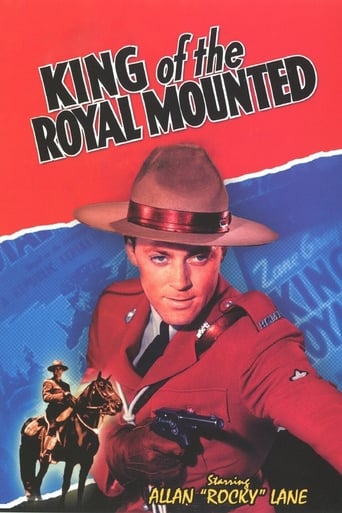
King of the Royal Mounted (1940)
THE KING OF YOUR FAVORITE CARTOON STRIPS BECOMES THE ADVENTURE KING OF THE SCREEN!
The Canadians have discovered a valuable substance called Compound X, which can cure infantile paralysis. When a country at war with Canada learns that Compound X also contains magnetic properties that could aid them in their warfare against the British, they send agents to infiltrate Canada and steal a large quantity of the substance. It's up to Sgt. King (Allan Lane) and his Mounties to track down the agents and put an end to their scheme.
- Date of release
- 1940-09-19
- TMDB
- 7.5 / 10 (2)
- Runtime
- 3h 31m
- Genres
- Western, Action, Adventure
- Director
- John English, William Witney
Casting
- Allan Lane — Dave King
- Robert Strange — John Kettler
- Robert Kellard — Tom Merritt, Jr.
- Lita Conway — Linda Merritt
- Herbert Rawlinson — Ross King
- Harry Cording — Wade Garson
- Bryant Washburn — Matt Crandall
- Budd Buster — Vinegar Smith
- Stanley Andrews — Tom Merritt Sr.
- John Davidson — Shelton
- John Dilson — Wall
- Paul McVey — Zarnoff
Interesting facts
- Budget: $136.7K
King of the Royal Mounted (1940) is a Republic Pictures northern serial based on the King of the Royal Mounted comic strip directed by William Witney and John English.
Production
King of the Royal Mounted was budgeted at $136,686 although the final negative cost was $137,874 (a $1,188, or 0.9%, overspend). It was the cheapest Republic serial of 1940 which was the first year in which Republic's overall spending on serial production was less than in the previous year. It was filmed between 18 June and 12 July 1940. The serial's production number was 998.
Republic found success with this naming scheme following this adaptation and subsequently liked calling their heroes "King" in order to use the title "King of ..." It even led the studio to name Roy Rogers "King of the Cowboys".
Director William Witney records that production of the serial was not pleasant. Although the interview for the leading man went well, neither Witney nor his partner John English subsequently had a high opinion of Allan Lane as a person or as an actor. The serial is only afforded three pages in the autobiography of his serial-years, in a chapter entitled "Two Duds and a Hot Water Tank".
Filming took place on location, following a good weather forecast from a Doctor Krich at Caltech, at Big Bear Lake. The area had a log cabin settlement and a disguised dam (logs covering concrete) built by Paramount Pictures for The Trail of the Lonesome Pine (1936). The area also had the pine trees necessary for the Canadian setting.
Read on Wikipedia · Text from Wikipedia, CC BY-SA 4.0. Data from Wikidata.
Recommended
- North West Mounted Police 1940 · ★ 6.4
- The Unholy Trinity 2025 · ★ 6.3
- True Grit 1969 · ★ 7.3
- The Isolate Thief 2026 · ★ 7.1
- Gunslingers 2025 · ★ 6.1
- No Name on the Bullet 1959 · ★ 6.6
- Gunfight at Rio Bravo 2023 · ★ 6.4
- Death Hunt 1981 · ★ 6.6
- Mackenna's Gold 1969 · ★ 6.6
- The Mountain Men 1980 · ★ 5.9
- Boss Nigger 1975 · ★ 6.7
- The Quick and the Dead 1987 · ★ 6.4