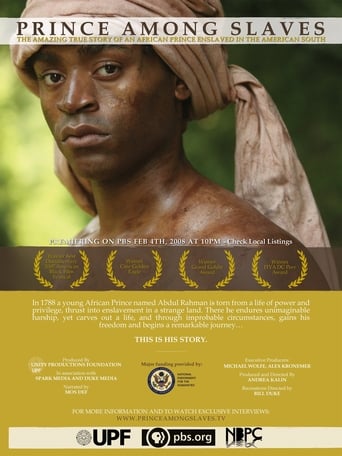
Prince Among Slaves (2008)
Abdul Rahman, an African prince who was sold into slavery, spent four decades in servitude before an amazing coincidence took him to the White House to meet President John Quincy Adams, where he was granted his freedom. Mos Def narrates this PBS documentary that includes reenactments of scenes from Rahman's life and interviews with historians who discuss the conditions faced by slaves in early America.
- Data di uscita
- 2008-02-04
- TMDB
- 6.0 / 10 (1)
- Durata
- 58 min
- Generi
- Documentario
- Regista
- Bill Duke, Andrea Kalin
Cast
- John C. Bailey — Andrew Marschalk
- Yasiin Bey — Narrator
- Henian Boone — Middle Passage
- Ian Coblyn — Young Abdul-Rahman / Middle Passage
- David Elvove — Henry Clay (voice)
- Tyler Gatton — Mouth harp player / child
- Bruce Holmes — Thomas Foster
- Andreu Honeycutt — Samba
- Lewis Sheridan Hughes — Various backround characters
- Isaiah Johnson — Middle Passage
- Marcus Mitchell — Prince Ibrahima Abdul Rahman
- Theodore M. Snead — David Walker
Curiosità
Prince Among Slaves is a 2007 historical drama directed, written and produced by Andrea Kalin and narrated by Mos Def made for PBS by Unity Productions Foundation. The film, made in association with Spark Media and Duke Media, is based on the story of Abdul Rahman Ibrahima Sori, a prince from Guinea who was made a slave in the United States and freed 40 years later.
Background
The producers were drawn to the project during the spiritual turmoil that followed the September 11, 2001 attacks. According to Alex Kronemer, one of Unity Productions Foundation's executive producers, the story brought up a question about the plight of slaves completely disconnected from their native cultures. "In times of great tension and stress, people seek out their religious connections.
That Abdul-Rahman had a religion, and was a Muslim, and a prince all at once, upsets many stereotypes, according to Director Andrea Kalin, whose films generally focus on bridging communication gaps between cultures. "Many people don't realize that up to 30 percent of slaves that came to America were Muslim. That didn't last past the first generation, but their customs are still evident in blues and some of the South's food."
"It's a universal story." Kronemer said. "It's paradise lost. We all wonder what would happen if we lost it all. Here's a story about someone who lost an entire empire and emerged intact." At the time of his capture in 1788, Abdul-Rahman commanded an army bigger than George Washington's in a country larger than the 13 original U.S. states.
It was Abdul-Rahman's extraordinary status that makes the story exemplify the ordinary in the experience of slavery, according to Mary McNamara of the Los Angeles Times. "His education and his brief fame make it a bit easier to tell his story, to know the sequence of certain events, the thoughts in his mind. But every one of the 16 million Africans abducted and sold had a similar story.
Leggi su Wikipedia · Testo da Wikipedia, CC BY-SA 4.0. Dati da Wikidata.
Consigliati
- Ragazzo americano 1978 · ★ 6.7
- I Am Ali 2014 · ★ 6.7
- Becoming: La mia storia 2020 · ★ 7.2
- Capital in the Twenty-First Century 2019 · ★ 6.5
- To Be Takei 2014 · ★ 7.2
- U.S.A. contro John Lennon 2006 · ★ 6.6
- Essere James Bond 2021 · ★ 7.8
- Amazing Grace 2018 · ★ 7.1
- The Irishman - Parlano i protagonisti 2019 · ★ 7.5
- Harry Dean Stanton: Partly Fiction 2013 · ★ 6.9
- Naqoyqatsi 2002 · ★ 6.2
- Cuore di un cane 2015 · ★ 6.5