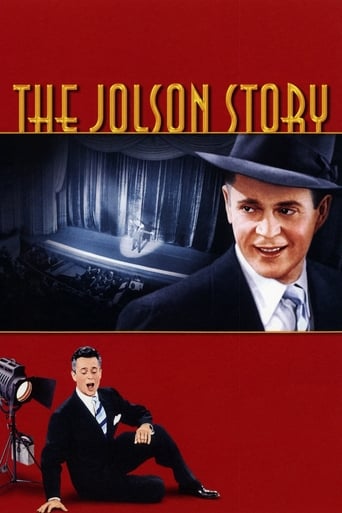
The Jolson Story (1946)
At the turn of the 20th century, young Asa Yoelson decides to go against the wishes of his cantor father and pursue a career in show business. Gradually working his way up through the vaudeville ranks, Asa — now calling himself Al Jolson — joins a blackface minstrel troupe and soon builds a reputation as a consummate performer. But as his career grows in size, so does his ego, resulting in battles in business as well as in his personal life.
- Data lansării
- 1946-10-10
- TMDB
- 6.8 / 10 (18)
- Durată
- 2 h 8 min
- Genuri
- Dramă, Muzică
- Regizor
- Alfred E. Green
Distribuție
- Larry Parks — Al Jolson
- Evelyn Keyes — Julie Benson
- William Demarest — Steve Martin
- Bill Goodwin — Tom Baron
- Ludwig Donath — Cantor Yoelson
- Scotty Beckett — Asa Yoelson
- Tamara Shayne — Mrs. Yoelson
- Jo-Carroll Dennison — Ann Murray
- John Alexander — Lew Dockstader
- Ernest Cossart — Father McGee
- Lilian Bond — Woman (uncredited)
- Frank Baker — Audience Member (uncredited)
Curiozități
- Premii: 2 · Nominalizări: 6. Inclusiv: Premiul Oscar pentru cea mai bună coloană sonoră; Premiul Oscar pentru cel mai bun mixaj sonor
The Jolson Story is a 1946 American biographical musical film, a highly fictionalized account of the life of singer Al Jolson, produced by Columbia Pictures and directed by Alfred E. Green. It stars Larry Parks as Jolson, Evelyn Keyes as Julie Benson, William Demarest as his performing partner and manager, Ludwig Donath and Tamara Shayne as his parents, and Scotty Beckett as the young Jolson. Some of the film's episodes are based on fact but the story is extremely simplified, with people disguised or combined into single characters.
Production
The film was the idea of Sidney Skolsky. In 1943 he pitched a Jolson biopic to Warner Bros, for whom Jolson had made The Jazz Singer, but Jack Warner was unenthusiastic, as Jolson's career was in a slump at the time. No other studios were interested either apart from Harry Cohn at Columbia. He agreed to make the movie and assigned Sidney Buchman to oversee it.
Skolsky sold the project to Cohn without first securing the rights from Jolson himself. When Columbia approached Jolson, the performer announced he had received an offer from Warner Bros. for $250,000 and a promise that the film would be directed by Michael Curtiz, who had just made Yankee Doodle Dandy for Warners. Columbia counter-offered 50% of the profits and promised that the film would receive special attention from the studio.
The biography was announced in December 1943 under the title Minstrel Boy, with Jolson set as both star and producer. The title had to be changed because PRC was then producing its most elaborate musical, Minstrel Man (released in 1944), starring Jolson contemporary Benny Fields.
Skolsky wrote the biggest problem with the film was to make Jolson a "lovable showoff". He claimed he came up with the idea of Jolson being someone who needed to see people's faces being happy while he sang. Many different writers worked on the script. Sidney Buchman claimed he felt the secret to the film was making it a love story, where Jolson was in love with applause.
According to Skolsky the "best material" came from writer Stephen Longstreet but that "at least three-fourths" of the final script was written by the uncredited John Howard Lawson.
Citește pe Wikipedia · Text din Wikipedia, CC BY-SA 4.0. Date din Wikidata.
Recomandate
- Grace Unplugged 2013 · ★ 6.0
- Dincolo de mare 2004 · ★ 6.3
- Too Late Blues 1961 · ★ 6.4
- The Five Heartbeats 1991 · ★ 7.2
- Honeydripper 2007 · ★ 5.9
- Simfonia americană 1942 · ★ 7.0
- Taking Sides 2002 · ★ 6.3
- Köln 75 2025 · ★ 7.2
- 'Round Midnight 1986 · ★ 7.1
- Eight Men Out 1988 · ★ 6.8
- Fata 2012 · ★ 6.2
- Războiul actual 2018 · ★ 6.7