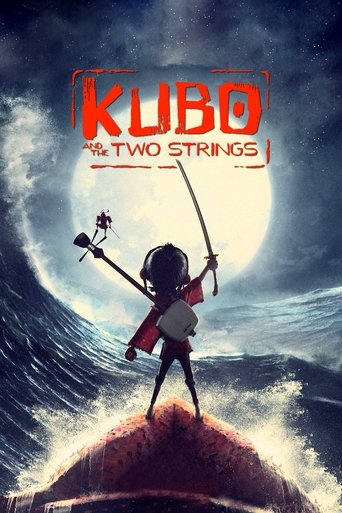
Kubo and the Two Strings (2016)
If you must blink, do it now!
Kubo mesmerizes the people in his village with his magical gift for spinning wild tales with origami. When he accidentally summons an evil spirit seeking vengeance, Kubo is forced to go on a quest to solve the mystery of his fallen samurai father and his mystical weaponry, as well as discover his own magical powers.
- Date of release
- 2016-08-18
- TMDB
- 7.7 / 10 (4018)
- Runtime
- 1h 42m
- Genres
- Animation, Adventure, Family
- Director
- Travis Knight
Casting
- Art Parkinson — Kubo (voice)
- Charlize Theron — Monkey / Mother (voice)
- Matthew McConaughey — Beetle / Hanzo (voice)
- Brenda Vaccaro — Kameyo (voice)
- Ralph Fiennes — Moon King (voice)
- Rooney Mara — The Sisters (voice)
- George Takei — Hosato (voice)
- Cary-Hiroyuki Tagawa — Hashi (voice)
- Meyrick Murphy — Mari (voice)
- Minae Noji — Minae (voice)
- Alpha Takahashi — Aiko (voice)
- Laura Miro — Miho (voice)
Interesting facts
- Box office: $76.2M
- Budget: $60M
- Earned 1.3× its budget
- Awards: 0 · Nominations: 5
Kubo and the Two Strings is a 2016 American epic stop-motion animated fantasy film directed by Travis Knight and written by Marc Haimes and Chris Butler. Produced by Laika, the film stars the voices of Charlize Theron, Art Parkinson, Ralph Fiennes, George Takei, Cary-Hiroyuki Tagawa, Brenda Vaccaro, Rooney Mara, and Matthew McConaughey. Set in feudal Japan, the film revolves around Kubo (Parkinson), a young boy who wields a magical musical instrument and whose left eye was stolen during infancy.
Production
Kubo and the Two Strings was announced by the stop-motion animation studio Laika in December 2014, and is the directorial debut of Laika's CEO Travis Knight. Laika's production designer Shannon Tindle pitched the story to Knight as a "stop-motion samurai epic".
The art took inspiration from such Japanese media as ink wash painting and origami among others. A particular influence came from the ukiyo-e woodblock printing style, with Laika intending to make the entire film "to look and feel as if it's a moving woodblock print" A second major influence on the film included the works of Kiyoshi Saito, who was a 20th-century Japanese graphic artist.
The art of Kiyoshi Saito was a strong influence on the style of the animation. In an interview, director Travis Knight described Saito's work as being the "touchstone" and the "one key visual artist" that inspired the film. Knight also describes being profoundly affected by the artist's interest in both eastern and western art styles and fusing them together in his works.
For the giant skeleton, the team created a giant 16 ft (5 m), 400 lb (180 kg) puppet, which Laika claims is the record holder for largest stop-motion puppet. The idea to make such a massive puppet was born out of a fear that individual smaller parts (meant to represent the larger monster) would not work well on screen interacting with the other puppets. The resulting puppet was built in two parts which were then attached together by magnets.
A small portion of the production was released on YouTube.
Read on Wikipedia · Text from Wikipedia, CC BY-SA 4.0. Data from Wikidata.
Recommended
- The House of Magic 2013 · ★ 6.3
- Epic 2013 · ★ 6.6
- Monster Family 2017 · ★ 6.0
- Monster Family 2 2021 · ★ 6.7
- Tinker Bell 2008 · ★ 7.0
- The Inseparables 2023 · ★ 6.6
- Forgotten Island 2026 · ★ 8.0
- In Your Dreams 2025 · ★ 6.9
- Spellbound 2024 · ★ 6.5
- The Pagemaster 1994 · ★ 6.4
- Barbie and the Magic of Pegasus 2005 · ★ 7.3
- The Boxtrolls 2014 · ★ 6.7