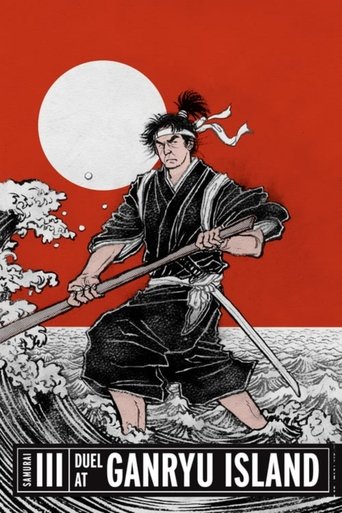
Samurai III: Duel at Ganryu Island (1956)
宮本武蔵完結編 決闘巌流島
A humble and simple Takezo abandons his life as a knight errant. He's sought as a teacher and vassal by Shogun, Japan's most powerful clan leader. He's also challenged to fight by the supremely confident and skillful Sasaki Kojiro. Takezo agrees to fight Kojiro in a year's time but rejects Shogun's patronage, choosing instead to live on the edge of a village, raising vegetables. He's followed there by Otsu and later by Akemi, both in love with him. The year ends as Takezo assists the villagers against a band of brigands. He seeks Otsu's forgiveness and accepts her love, then sets off across the water to Ganryu Island for his final contest.
- Date of release
- 1956-01-03
- TMDB
- 7.2 / 10 (144)
- Runtime
- 1h 45m
- Genres
- Action, Adventure, Drama, Romance, History
- Director
- Hiroshi Inagaki
- Collection
- Samurai Collection
Casting
- Toshirō Mifune — Musashi Miyamoto a.k.a. Takezo
- Koji Tsuruta — Kojiro Sasaki
- Kaoru Yachigusa — Otsu
- Mariko Okada — Akemi
- Kuroemon Onoe II — Takuan
- Michiko Saga — Omitsu
- Takashi Shimura — Court official
- Minoru Chiaki — Sasuke the boatman
- Takamaru Sasaki — Omitsu's father
- Haruo Tanaka — Kumagoro the horse thief
- Kichijirō Ueda — Priest Ogon
- Ikio Sawamura — Innkeeper (uncredited)
Interesting facts
Samurai III: Duel at Ganryu Island is a 1956 Japanese film directed by Hiroshi Inagaki and starring Toshirō Mifune. Shot in Eastmancolor, it is the third and final film of Inagaki's Samurai Trilogy.
Production
The film Samurai III: Duel at Ganryu Island, made in 1956, came after the end of the Allied occupation of Japan following World War II. "The Allied occupation initially restricted films promoting feudal values, putting the kibosh on this most Japanese of action genres".
This attitude relaxed somewhat in 1949, as the Occupation became more concerned with the threat of international communism and less with jidaigeki and chanbara. Inagaki himself had directed Kanketsu Sasaki Kojirô: Ganryû-jima kettô, an earlier black and white film about Sasaki that climaxes with the fatal duel between Miyamoto and Sasaki, in 1951.
After the Allies left Japan in 1952, "the way was clear for the golden age of the samurai film", allowing Inagaki to specialize in the genre he had been most closely associated with before the war. World War II, the Allied occupation of Japan and then the Allies leaving certainly influenced Japanese film.
Read on Wikipedia · Text from Wikipedia, CC BY-SA 4.0. Data from Wikidata.
Recommended
- 13 Assassins 2010 · ★ 7.3
- Samurai I: Musashi Miyamoto 1954 · ★ 7.2
- Samurai II: Duel at Ichijoji Temple 1955 · ★ 7.2
- Gate of Hell 1953 · ★ 7.1
- The Twilight Samurai 2002 · ★ 7.8
- Samurai Assassin 1965 · ★ 7.3
- 47 Ronin 2013 · ★ 6.2
- Love and Honor 2006 · ★ 7.4
- Seven Samurai 1954 · ★ 8.5
- Rurouni Kenshin: The Final 2021 · ★ 7.7
- Rurouni Kenshin: The Beginning 2021 · ★ 7.7
- Taboo 1999 · ★ 6.6