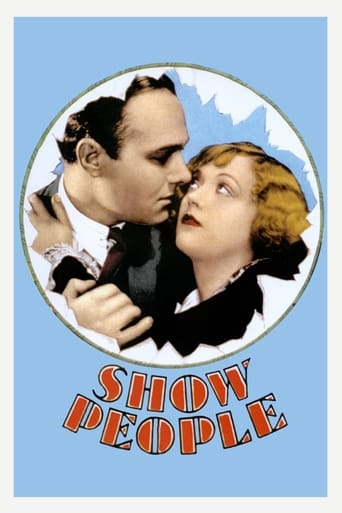
Show People (1928)
Hollywood hopeful Peggy Pepper arrives at a major studio, from Georgia, to become a great dramatic star. Things don't go entirely according to plan.
キャスト
- Marion Davies — Peggy Pepper
- William Haines — Billy Boone
- Dell Henderson — Colonel Pepper
- Paul Ralli — Andre Telfair
- Tenen Holtz — Casting Director
- Harry Gribbon — Comedy Director
- シドニー・ブレイシー — Dramatic Director
- Polly Moran — Maid
- Albert Conti — Producer
- John Gilbert — John Gilbert (uncredited)
- チャールズ・チャップリン — Charlie Chaplin (uncredited)
- Renée Adorée — Renée Adorée (uncredited)
豆知識
- 興行収入:$110万
- 製作費:$43.1万
- 製作費の2.6倍を稼ぎました
- 撮影地:ロサンゼルス
Show People is a 1928 American synchronized sound comedy film directed by King Vidor. While the film has no audible dialog, it was released with a synchronized musical score with sound effects using both the sound-on-disc and sound-on-film processes. The film was a starring vehicle for actress Marion Davies and actor William Haines and included notable cameo appearances by many of the film personalities of the day, including stars Charlie Chaplin, Douglas Fairbanks, William S. Hart and John Gilbert, and writer Elinor Glyn. Vidor also appears in a cameo as himself, as does Davies.
Production
Show People offers a comic look at 1920s Hollywood and stardom. The main character of Peggy Pepper, who becomes the self-important dramatic star, Patricia Pepoire, was based on the careers of silent divas Gloria Swanson and Mae Murray. When asked, Davies supposedly told Murray the character was based on Swanson. Davies also told Swanson the character was based on Murray, but Swanson did not care since she had no inclination to see the film.
The film has a remarkable number of cameo appearances from some of the top stars of the day, including Charlie Chaplin, Douglas Fairbanks, William S. Hart, Norma Talmadge, Leatrice Joy, Lew Cody, Eleanor Boardman, and others. Many agreed to appear out of friendship with Davies, Hearst, and director Vidor, and the positive publicity value of cooperating with Hearst and MGM also played a factor.
In one of the film's more famous sequences, the script originally called for Davies to get hit in the face with a pie after being tricked appearing in a slapstick comedy movie. William Randolph Hearst objected to this, fearing for Marion Davies' dignity, and as a compromise, the scene was changed (without Hearst's knowledge) to have Davies get hit in the face with spray from a seltzer bottle.
Vidor had wanted James Murray for the role of Billy Boone, but he was unavailable. Davies jumped at the chance to cast close friend William Haines in the role and agreed to Haines's receiving billing above the title with her. This was the only silent film in which Davies shared star billing. Once again, the reviews raved about Davies' comedic touch, and the film was a huge hit at the box office.
The closing scene on the set of a war movie may be a nod to King Vidor's The Big Parade, a smash hit made in 1925, but more closely resembles the Davies film Marianne.
Wikipediaで続きを読む · テキストはWikipedia、CC BY-SA 4.0。データはWikidata。
おすすめ
- 恋をしましょう 1960 · ★ 6.4
- Bowfinger 1999 · ★ 6.2
- How to Succeed in Business Without Really Trying 1967 · ★ 6.7
- Watching the Detectives 2007 · ★ 6.3
- 恋人よ帰れ 1961 · ★ 7.0
- ミンクの手ざわり 1962 · ★ 6.5
- A Hollywood Christmas 2022 · ★ 6.1
- 雨に唄えば 1952 · ★ 8.1
- ロック・ハンターはそれを我慢できるか? 1957 · ★ 6.8
- Girl on a Bicycle 2013 · ★ 5.9
- A Burlesque on Carmen 1915 · ★ 5.8
- ビッグ・ライアー 2002 · ★ 5.9