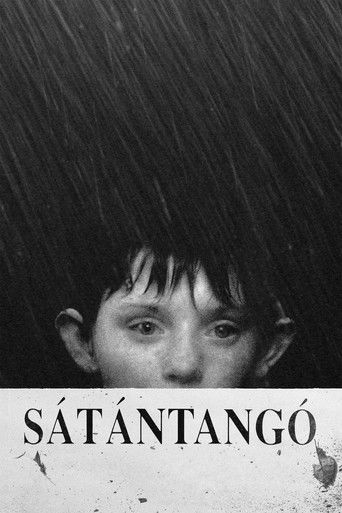
Satantango (1994)
Sátántangó
Inhabitants of a small village in Hungary deal with the effects of the fall of Communism. The town's source of revenue, a factory, has closed, and the locals, who include a doctor and three couples, await a cash payment offered in the wake of the shuttering. Irimias, a villager thought to be dead, returns and, unbeknownst to the locals, is a police informant. In a scheme, he persuades the villagers to form a commune with him.
Casting
- Mihály Víg — Irimiás
- Putyi Horváth — Petrina
- Székely B. Miklós — Futaki
- Erika Bók — Estike
- László feLugossy — Schmidt
- Alfréd Járai — Halics
- János Derzsi — Kráner
- Irén Szajki — Kránerné
- Éva Almássy Albert — Schmidtné
- Erzsébet Gaál — Halicsné
- Peter Berling — Orvos
- György Barkó — Iskolaigazgató
Interesting facts
- Based on: Satantango
Sátántangó is a 1994 Hungarian black-and-white epic drama film directed by Béla Tarr, co-written by Tarr and László Krasznahorkai, and edited by Ágnes Hranitzky. Hranitzky is also listed in András Bálint Kovács's filmography as Tarr's directorial collaborator on the film. Running for more than seven hours, it is based on the 1985 novel by Krasznahorkai, whose works Tarr frequently adapted after his 1988 film Damnation. Tarr had hoped to make the film since 1985 but was unable to proceed with production due to the strict political environment in Hungary.
Production
Sátántangó was made during the long collaboration between Béla Tarr and editor Ágnes Hranitzky. Hranitzky edited the film and is listed in András Bálint Kovács's filmography as Tarr's directorial collaborator on the project. The film was made before Hranitzky's later formal co-director credits from Werckmeister Harmonies onward.
The film's long-take structure made editing part of the film's formal design rather than only a stage of post-production. In the Tarr–Hranitzky working method, questions of rhythm, duration, camera movement and the relation between one shot and the next had to be anticipated during shooting. This gave Hranitzky's role particular importance in shaping the film's temporal structure and rhythm.
The structure of the film is based on that of the novel, which borrows, as its title suggests, from tango. The film is broken into twelve parts, and does not always move chronologically, as it follows the tango scheme of going six moves forward, then six back (hence 6 + 6 parts in total). The twelve parts are titled as follows (in the original Hungarian and in English translation):
A hír, hogy jönnek [News of Their Coming]
A pók dolga II (Ördögcsecs, sátántangó) [The Job of the Spider II (The Devil's Tit, Satan's Tango)]
Read on Wikipedia · Text from Wikipedia, CC BY-SA 4.0. Data from Wikidata.
Recommended
- Dogville 2003 · ★ 7.7
- The Brutalist 2024 · ★ 6.9
- Angela's Ashes 1999 · ★ 7.3
- Apocalypse Now 1979 · ★ 8.3
- Escape from Sobibor 1987 · ★ 7.2
- Killers of the Flower Moon 2023 · ★ 7.4
- Blonde 2022 · ★ 5.9
- The Deer Hunter 1978 · ★ 8.0
- El Chicano 2019 · ★ 6.6
- The Godfather 1972 · ★ 8.7
- Nuremberg 2025 · ★ 7.6
- The Brothers Karamazov 1958 · ★ 6.5