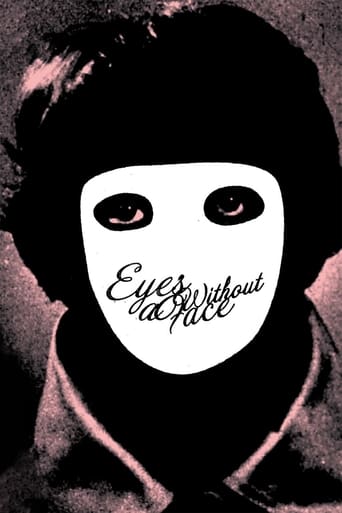
Eyes Without a Face (1960)
Les Yeux sans visage
The horror film with a heart of mystery.
Dr. Génessier is riddled with guilt after an accident that he caused disfigures the face of his daughter, the once beautiful Christiane, who outsiders believe is dead. Dr. Génessier, along with accomplice and laboratory assistant Louise, kidnaps young women and brings them to the Génessier mansion. After rendering his victims unconscious, Dr. Génessier removes their faces and attempts to graft them on to Christiane's.
- Date of release
- 1960-01-11
- TMDB
- 7.6 / 10 (844)
- Runtime
- 1h 24m
- Genres
- Drama, Horror, Thriller
- Director
- Georges Franju
Casting
- Pierre Brasseur — Professor Génessier
- Alida Valli — Louise
- Édith Scob — Christiane Génessier
- Juliette Mayniel — Edna Gruber
- Alexandre Rignault — Inspector Parot
- Béatrice Altariba — Paulette Mérodon
- Charles Blavette — Man from the Pond
- Michel Etcheverry — Doctor Lherminier, forensic surgeon
- Claude Brasseur — Police inspector
- Yvette Etiévant — Mother of the little sick man
- René Génin — Emile Tessot
- Lucien Hubert — Man at the funeral
Interesting facts
Eyes Without a Face is a 1960 horror film directed by Georges Franju and starring Pierre Brasseur, Alida Valli, Juliette Mayniel, and Édith Scob. Based on a 1959 novel by Jean Redon, who also co-wrote the screenplay, it centers on a plastic surgeon who is determined to perform a face transplant on his daughter, who was disfigured in a car crash.
Production
At the time, modern horror films had not been attempted by French film makers until producer Jules Borkon decided to tap into the horror market. The project was initially conceived as a French response to the success of British Hammer horror films, with producer Jules Borkon seeking to develop a contemporary French horror production.
The original novel on which the film is based was the debut of Jean Redon, a former journalist-turned-film publicist and screenwriter. For years, a rumor persisted that "Redon" was actually a pen name for prolific pulp novelist Frédéric Dard, apparently arising from a contribution of a back-cover quote for the paperback.
To avoid problems with European censors, Borkon cautioned Franju not to include too much blood (which would upset French censors), refrain from showing animals getting tortured (which would upset English censors) and leave out mad-scientist characters (which would upset German censors). All three of these were part of the novel, presenting a challenge to find the right tone for presenting these story elements in the film.
For his production staff, Franju enlisted people with whom he had previously worked on earlier projects. Cinematographer Eugen Schüfftan, best remembered for developing the Schüfftan process, was chosen to render the visuals of the film. Schüfftan had worked with Franju on La Tête Contre les Murs (1958). Film historian David Kalat called Shüfftan "the ideal choice to illustrate Franju's nightmares".
Read on Wikipedia · Text from Wikipedia, CC BY-SA 4.0. Data from Wikidata.
Recommended
- Crimes of the Future 2022 · ★ 6.0
- The Experiment 2010 · ★ 6.4
- The Truth About Emanuel 2013 · ★ 6.0
- Get Out 2017 · ★ 7.6
- Victor Frankenstein 2015 · ★ 6.0
- Werewolf: The Beast Among Us 2012 · ★ 5.9
- American Mary 2013 · ★ 6.3
- Rogue Agent 2022 · ★ 6.3
- Doctor X 1932 · ★ 6.0
- Goodnight Mommy 2022 · ★ 6.3
- Frankenstein 2025 · ★ 7.6
- The Ritual 2025 · ★ 5.8