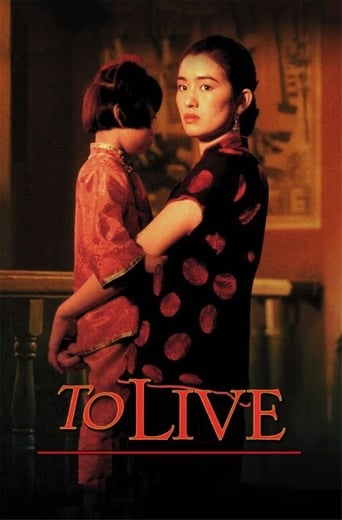
To Live (1994)
活着
Married couple Fugui and Jiazhen endure tumultuous events in mid-20th century mainland China as their personal fortunes move from wealthy landownership to peasantry.
- Date of release
- 1994-05-18
- TMDB
- 8.1 / 10 (411)
- Runtime
- 2h 13m
- Genres
- Drama, Romance, War
- Director
- Zhang Yimou
Casting
- Ge You — Xu Fugui
- Gong Li — Xu Jiazhen
- Niu Ben — Town Chief
- Guo Tao — Chunsheng
- Jiang Wu — Wan Erxi
- Ni Dahong — Long'er
- Liu Tianchi — Xu Fengxia
- Zhang Lu — Young Fengxia
- Dong Fei — Xu Youqing
- Huang Zongluo — Fugui's Dad
- Liu Yanjin — Fugui's Mom
- Li Lianyi — Sgt. Lao Quan
Interesting facts
- Box office: $2.3M
- Based on: To Live
- Awards: 1 · Nominations: 0. Including: Cannes Film Festival Grand Prix
To Live, also known as Lifetimes, is a 1994 Chinese drama film directed by Zhang Yimou and adapted from Yu Hua's 1993 novel of the same name. The film spans the 1940s–1970s, tracing the Xu family's survival through the Chinese Civil War, Great Leap Forward, and Cultural Revolution. It won numerous prestigious international awards, and despite domestic censorship, is widely respected for its portrayal of ordinary resilience under political duress.
Production
Zhang Yimou originally intended to adapt Mistake at River's Edge, a thriller written by Yu Hua. Yu gave Zhang a set of all of the works that had been published at that point so Zhang could understand his works. Zhang said when he began reading To Live, one of the works, he was unable to stop reading it. Zhang met with Yu to discuss the script for Mistake at River's Edge, but they kept bringing up To Live.
Ge You, known for his comedic roles, was chosen by Zhang Yimou to play the title character, Fugui. Known for poker-faced comedy, he was not accustomed to expressing emotional states this character requires. Thus, he was not very confident in himself, even protesting going to the Cannes Film Festival where he would eventually garner a best actor award.
For Gong Li, To Live was her fifth collaboration with Zhang as director, following Red Sorghum (1987), Ju Dou (1990), Raise the Red Lantern (1991), and The Story of Qiu Ju (1992); the partnership had defined the international image of contemporary Chinese cinema by the early 1990s.
Zhang spent his youth during the Cultural Revolution, an experience that influenced his later perspective on Chinese culture and society.
As a student who studied screen studies in university in the country's capital city, he and his peers were heavily exposed to various movies from across the world and across time. His classmate, who is now the President of the Beijing Film Academy, stated that during their four years in university, they went through over 500 films, spanning from Hollywood films from the 1930s to Italian Neo-Realism.
Read on Wikipedia · Text from Wikipedia, CC BY-SA 4.0. Data from Wikidata.
Recommended
- The History of Love 2016 · ★ 6.4
- Red Sorghum 1988 · ★ 7.3
- Youth 2017 · ★ 7.3
- Private Peaceful 2012 · ★ 6.6
- Not Easily Broken 2009 · ★ 6.3
- Christmas Cottage 2008 · ★ 6.3
- When Nietzsche Wept 2007 · ★ 6.1
- Waiting for Anya 2020 · ★ 6.3
- Possession 2002 · ★ 6.0
- Breathe 2017 · ★ 7.4
- Shanghai Express 1932 · ★ 7.0
- Jade Dynasty 2019 · ★ 7.4