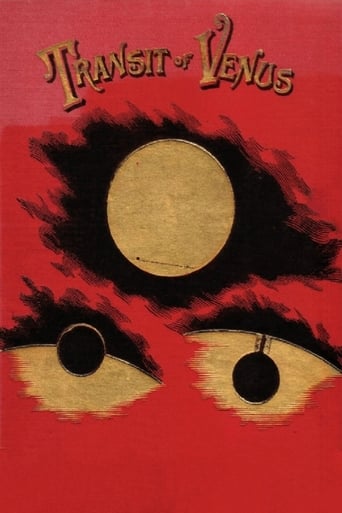
Passage of Venus (1874)
Passage de Venus
Photo sequence of the rare transit of Venus over the face of the Sun, one of the first chronophotographic sequences. In 1873, P.J.C. Janssen, or Pierre Jules César Janssen, invented the Photographic Revolver, which captured a series of images in a row. The device, automatic, produced images in a row without human intervention, being used to serve as photographic evidence of the passage of Venus before the Sun, in 1874.
- Date of release
- 1874-12-09
- TMDB
- 6.4 / 10 (150)
- Runtime
- 1m
- Genres
- Documentary
- Director
- P.J.C. Janssen, Francisco Antônio de Almeida Júnior
Interesting facts
- Filmed in: Nagasaki Prefecture
Passage de Vénus is a series of photographs of the transit of the planet Venus across the Sun on 9 December 1874. They were purportedly taken in Japan by the French astronomer Jules Janssen and Brazilian engineer Francisco Antônio de Almeida using Janssen's 'photographic revolver'.
Filming the transit
Due to the popularity of the event, numerous expeditions to over 80 locations were ventured, and many expeditions considered the best way by which to record the event. Frenchman inventor Janssen came up with the idea for a "revolver photographic". This was a large camera based on the Maltese cross mechanism, which is an important milestone in the development of cameras used to film movies.
Read on Wikipedia · Text from Wikipedia, CC BY-SA 4.0. Data from Wikidata.
Recommended
- Interstellar: Nolan's Odyssey 2014 · ★ 7.8
- Roundhay Garden Scene 1888 · ★ 6.5
- As I Was Moving Ahead Occasionally I Saw Brief Glimpses of Beauty 2000 · ★ 7.8
- The Skywalker Legacy 2020 · ★ 7.9
- The Extraordinary Voyage 2011 · ★ 7.7
- The Arrival of a Train at La Ciotat 1896 · ★ 7.1
- Voyage of Time: The IMAX Experience 2016 · ★ 6.9
- Being James Bond 2021 · ★ 7.8
- Whispers in the Woods 2025 · ★ 7.9
- They'll Love Me When I'm Dead 2018 · ★ 7.1
- Koyaanisqatsi 1983 · ★ 7.9
- The Director and the Jedi 2018 · ★ 7.4