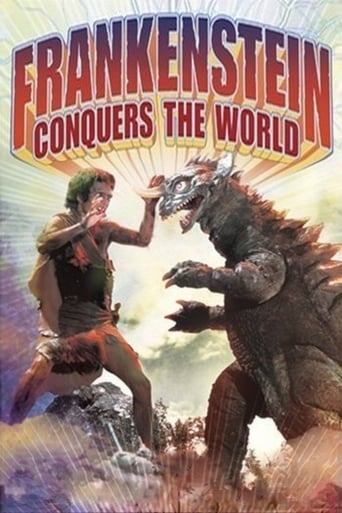
Frankenstein Conquers the World (1965)
フランケンシュタイン対地底怪獣
A fearsome kaijin? A mad new antagonistic kaiju? A golden entertainment epic of Japan-U.S. collaboration!
During WWII, Germans obtain the immortal heart of Frankenstein's monster and transport it to Japan to prevent it being seized by the Allies. Kept in a Hiroshima laboratory, it is seeming lost when the United States destroys the city with the atomic bomb. Years later a wild boy is discovered wandering the streets of the city alone, born of the immortal heart.
- Date of release
- 1965-08-08
- TMDB
- 6.7 / 10 (79)
- Runtime
- 1h 30m
- Genres
- Horror, Science Fiction, Action
- Director
- Ishirō Honda
- Collection
- Frankenstein (Toho) Collection
Casting
- Tadao Takashima — Dr. Yuzo Kawaji
- Nick Adams — Dr. James Bowen
- Kumi Mizuno — Dr. Sueko Togami
- Yoshio Tsuchiya — Daigo Kawai
- Koji Furuhata — Frankenstein
- Jun Tazaki — Hideo Nishi, Director of the Okayama Prefectural Police
- Susumu Fujita — Osaka Prefectural Police Chief
- Takashi Shimura — Hiroshima Army Hospital doctor
- Nobuo Nakamura — Dr. Suga
- Kenji Sahara — Tadokoro, Bowen's assistant
- Hisaya Ito — Osaka Police Sergeant
- Yoshibumi Tajima — Murata, Japanese Imperial Navy submarine captain
Interesting facts
- Based on: Frankenstein; or, The Modern Prometheus
Frankenstein vs. Baragon is a 1965 kaiju film directed by Ishirō Honda, with special effects by Eiji Tsuburaya. The film stars Nick Adams, Kumi Mizuno and Tadao Takashima, with Koji Furuhata as Frankenstein and Haruo Nakajima as Baragon. An international co-production of Japan and the United States, it was the first collaboration between Toho and Henry G. Saperstein. In the film, scientists investigate the origins of a mysterious monster boy Frankenstein and his resistance to radiation that makes him grow to monstrous size, while another monster Baragon ravages the countryside.
Production
In the early 1960s, special effects technician Willis H. O'Brien (who provided the stop motion animation for the 1933 film King Kong) proposed an idea for a new King Kong film to be filmed in color. O'Brien wrote a story outline titled King Kong vs. Frankenstein and succeeded in obtaining permission from RKO Pictures attorney Daniel O'Shea to use the King Kong character.
Behind O'Brien's back, Beck succeeded in striking a deal with Japanese studio Toho Co., Ltd (producers of the 1954 film Godzilla) to produce King Kong vs. Prometheus. Toho was only interested in acquiring the King Kong character and the project was redeveloped into King Kong vs. Godzilla. O'Brien attempted to sue (presumably Beck) over the deal with Toho but dropped the lawsuit due to mounting attorney fees and died on November 8, 1962.
Shortly after the release of King Kong vs. Godzilla, Toho began work on a film that would potentially feature the Frankenstein monster, or simply named "Frankenstein". Inspired by a story concept by John Meredyth Lucas (who wrote the American localizations for three of Toho's films), Toho conceived of Frankenstein vs. The Human Vapor and tasked Ishirō Honda to direct and Shinichi Sekizawa to write the script.
In 1964, Honda traveled to the United States to help finalize a deal with Henry G. Saperstein and his United Productions of America (UPA) studio. The deal would see UPA co-producing three films with Toho, with "the right of final decision" on the film by Honda. The deal also allowed Saperstein to attach Hollywood actors as the leads, to provide half the financing for territorial rights, and consultation on the scripts.
The idea for Frankenstein vs. Godzilla originated from UPA, with Jerry Sohl and Reuben Bercovitch providing the initial concept. Both writers retained credit for the story, but it is unclear how many of their ideas were retained in the final film. Takeshi Kimura's first draft, dated July 3, 1964, features many of the same elements in the final film.
Read on Wikipedia · Text from Wikipedia, CC BY-SA 4.0. Data from Wikidata.
Recommended
- The War of the Gargantuas 1966 · ★ 6.3
- Rodan 1956 · ★ 6.5
- Godzilla Minus One 2023 · ★ 7.6
- Godzilla Minus Zero 2026 · ★ 7.6
- Underwater 2020 · ★ 6.3
- Attack on Titan II: End of the World 2015 · ★ 6.3
- Gamera vs. Gyaos 1967 · ★ 6.0
- Shin Godzilla 2016 · ★ 7.3
- The Last House 2026 · ★ 6.7
- Godzilla: Tokyo S.O.S. 2003 · ★ 7.2
- Dogora 1964 · ★ 6.7
- Attack on Titan 2015 · ★ 6.3