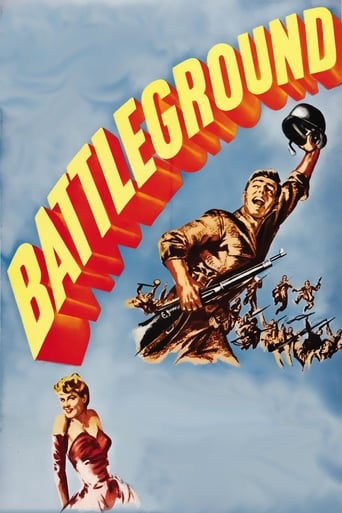
Battleground (1949)
The First Great Picture Of The Second World War!
Members of the U.S. Army's 101st Airborne Division are fighting for their country amidst the rugged terrain of Bastogne, Belgium, in December 1944. Holley and his American compatriots have already seen one of their own, Roderigues, perish under enemy fire. The men try to rebuff another series of Nazi attacks, but what they really need is a change in the weather. Without clear skies, they'll never get the air support they need.
- Date of release
- 1949-11-09
- TMDB
- 6.7 / 10 (109)
- Runtime
- 1h 58m
- Genres
- Action, Drama, War
- Director
- William A. Wellman
Casting
- Van Johnson — Holley
- John Hodiak — Jarvess
- Ricardo Montalban — Roderigues
- George Murphy — 'Pop' Stazak
- Marshall Thompson — Jim Layton
- Jerome Courtland — Abner Spudler
- Don Taylor — Standiferd
- Bruce Cowling — Wolowicz
- James Whitmore — Kinnie
- Douglas Fowley — 'Kipp' Kippton
- Leon Ames — The Chaplain
- Herbert Anderson — Hansan
Interesting facts
- Awards: 2 · Nominations: 6. Including: Academy Award for Best Writing, Original Screenplay; Academy Award for Best Cinematography, Black-and-White
Battleground is a 1949 American war film directed by William A. Wellman and starring Van Johnson, John Hodiak, Ricardo Montalbán, George Murphy, and James Whitmore. It follows a fictional company of the 327th Glider Infantry Regiment, 101st Airborne Division as they fight in the siege of Bastogne during the Battle of the Bulge, in World War II. The screenplay was written by Robert Pirosh, based on his own experiences during the battle.
Production
Robert Pirosh had based the script on his own experiences during the Battle of the Bulge, although he did not serve with the 101st Airborne, but with the 35th Infantry Division.
Many of the incidents in the film were based on actual events, including the rejection of a German demand for surrender on December 22, 1944, with Brig. Gen. Anthony McAuliffe's one word response, "Nuts!". Other events in the film, like Private Kipp's continual loss of his false teeth and Private Roderigues' having never seen snow before, were from Pirosh's experiences.
Battleground was originally an RKO property, titled "Prelude to Love" to hide its subject matter, but was shelved when production head Dore Schary resigned, despite $100,000 having been put into the property to that point. When Schary went to MGM, he purchased the rights to the script from RKO, over the objections of Louis B. Mayer, who believed the public was tired of war films.
Twenty veterans of the 101st were hired to train the actors and appeared in the film as extras. Lt Col Harry Kinnard, who had been the 101st's deputy divisional commander at Bastogne, was the film's technical advisor. Pirosh also consulted with McAuliffe, who was enthusiastic about Pirosh's intention to show World War II strictly from the grunt's eye view.
The role of Staff Sergeant Kinnie was first offered to Spencer Tracy, but he turned it down. Wellman and Pirosh's second choice was James Whitmore, a Broadway theatre actor and former Marine Corps officer, who also bore resemblance to Tracy. However, the producers insisted a more well-known actor be cast.
Read on Wikipedia · Text from Wikipedia, CC BY-SA 4.0. Data from Wikidata.
Recommended
- Walking with the Enemy 2014 · ★ 6.3
- Wolf Hound 2022 · ★ 6.4
- Hurricane 2018 · ★ 5.9
- Field of Lost Shoes 2015 · ★ 6.1
- Hell Hath No Fury 2021 · ★ 6.4
- Seal Team Eight: Behind Enemy Lines 2014 · ★ 6.1
- An Ordinary Man 2017 · ★ 6.3
- The Kill Team 2019 · ★ 6.5
- When Trumpets Fade 1998 · ★ 6.6
- For Greater Glory: The True Story of Cristiada 2012 · ★ 7.0
- Bat★21 1988 · ★ 6.3
- Sahara 1995 · ★ 6.7