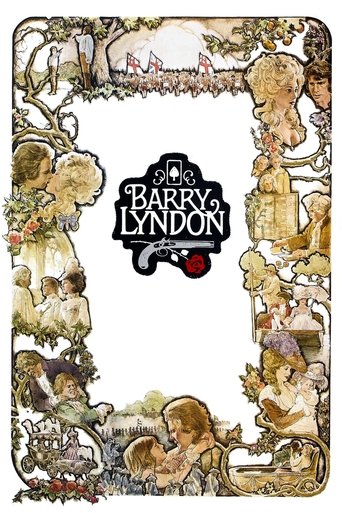
Barry Lyndon (1975)
Upstart. Soldier. Hero. Deserter. Scoundrel.
An Irish rogue uses his cunning and wit to work his way up the social classes of 18th century England, transforming himself from the humble Redmond Barry into the noble Barry Lyndon.
- Date of release
- 1975-12-16
- TMDB
- 8.0 / 10 (3374)
- Runtime
- 3h 8m
- Genres
- Drama, History
- Director
- Stanley Kubrick
Casting
- Ryan O'Neal — Barry Lyndon
- Marisa Berenson — Lady Lyndon
- Patrick Magee — The Chevalier
- Hardy Krüger — Captain Potzdorf
- Steven Berkoff — Lord Ludd
- Gay Hamilton — Nora
- Marie Kean — Barry's Mother
- Diana Körner — German Girl
- Murray Melvin — Reverend Runt
- Frank Middlemass — Sir Charles Lyndon
- Leon Vitali — Lord Bullingdon
- Arthur O'Sullivan — Highwayman
Interesting facts
- Box office: $20M
- Budget: $11M
- Earned 1.8× its budget
- Based on: The Luck of Barry Lyndon
- Filmed in: Oxfordshire, Powerscourt Estate, Kells Priory, Castle Howard, Blenheim Palace, Huntington Castle and 10 more
- Awards: 6 · Nominations: 7. Including: Academy Award for Best Cinematography; Academy Award for Best Costume Design; Academy Award for Best Production Design; Academy Award for Best Original Song Score
Barry Lyndon is a 1975 epic historical drama film written, produced, and directed by Stanley Kubrick, based on the 1844 novel The Luck of Barry Lyndon by William Makepeace Thackeray. Narrated by Michael Hordern, and starring Ryan O'Neal, Marisa Berenson, Patrick Magee, Leonard Rossiter, and Hardy Krüger, the film recounts the early exploits and later unravelling of an 18th-century Irish rogue and gold digger who marries a rich widow in order to attempt to climb the social ladder and assume her late husband's aristocratic position.
Production
After completing post production on 2001: A Space Odyssey, Kubrick resumed planning a film about Napoleon. During pre-production, Sergei Bondarchuk and Dino De Laurentiis's Waterloo was released, and failed at the box office. Reconsidering, Kubrick's financiers pulled funding, and he turned his attention towards a film adaptation of Anthony Burgess's 1962 novel A Clockwork Orange.
Having earned Oscar nominations for Dr. Strangelove, 2001: A Space Odyssey and A Clockwork Orange, Kubrick's reputation in the early 1970s was that of "a perfectionist auteur who loomed larger over his movies than any concept or star".
In 1972 Kubrick finally set his sights on Thackeray's 1844 "satirical picaresque about the fortune-hunting of an Irish rogue", The Luck of Barry Lyndon, the setting of which allowed Kubrick to take advantage of the copious period research he had done for the now-aborted Napoleon.
Kubrick based his adapted screenplay on William Makepeace Thackeray's The Luck of Barry Lyndon (republished as the novel Memoirs of Barry Lyndon, Esq.), a picaresque tale written and published in serial form in 1844.
The film departs from the novel in several ways. In Thackeray's writings, events are related in the first person by Barry himself. A comic tone pervades the work, as Barry proves both a raconteur and an unreliable narrator. Kubrick's film, by contrast, presents the story objectively. Though the film contains voice-over (by actor Michael Hordern), the comments expressed are not Barry's, but those of an omniscient narrator.
Read on Wikipedia · Text from Wikipedia, CC BY-SA 4.0. Data from Wikidata.
Recommended
- The Duellists 1977 · ★ 7.3
- Victoria & Abdul 2017 · ★ 6.9
- Young Washington 2026 · ★ 7.7
- The Guns of Navarone 1961 · ★ 7.3
- Les Misérables 2012 · ★ 7.3
- Richard Jewell 2019 · ★ 7.4
- The Prince and the Pauper 1977 · ★ 6.1
- Winged Creatures 2009 · ★ 5.9
- Giant 2026 · ★ 6.8
- Master and Commander: The Far Side of the World 2003 · ★ 7.2
- Invincible 2006 · ★ 7.0
- Seabiscuit 2003 · ★ 7.1