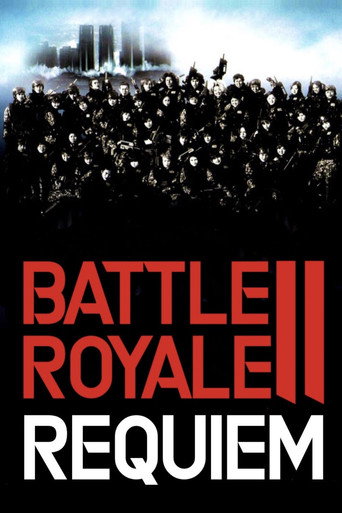
Battle Royale II: Requiem (2003)
バトル・ロワイアルII 鎮魂歌
This time it's war.
It's three years after the events of the original Battle Royale, and Shuya Nanahara is now an internationally-known terrorist determined to bring down the government. His terrorist group, Wild Seven, stages an attack that levels several buildings in Tokyo on Christmas Day, killing 8000 people. In order for the government to study the benefits of "teamwork", the new students work in pairs, with their collars electronically linked so that if one of them is killed, the other dies as well. They must kill Nanahara in three days - or die.
- Date of release
- 2003-07-05
- TMDB
- 5.0 / 10 (562)
- Runtime
- 2h 35m
- Genres
- Action, Thriller
- Director
- Kenta Fukasaku, Kinji Fukasaku
- Collection
- Battle Royale Collection
Casting
- Shugo Oshinari — Takuma Aoi
- Ai Maeda — Shiori Kitano
- Tatsuya Fujiwara — Shuya Nanahara
- Ayana Sakai — Nao Asakura
- Takeshi Kitano — Kitano
- Natsuki Kato — Saki Sakurai
- Aki Maeda — Noriko Nakagawa
- Riki Takeuchi — Riki
- Takeru Shibaki — Shugo Urabe
- Makoto Sakamoto — Osamu Kasai
- Yuki Ito — Ryo Kurosawa
- Ryo Katsuji — Haruya Sakurai
Interesting facts
- Based on: Battle Royale
Battle Royale II: Requiem is a 2003 Japanese dystopian action film directed by Kinji Fukasaku and Kenta Fukasaku, who co-wrote the screenplay with Norio Kida. It is the sequel to the 2000 film Battle Royale, which in turn was based on the 1999 novel of the same name by Koushun Takami. Unlike the first film, Requiem is an original story. It is set three years after the events of the previous film and follows Shuya Nanahara, who has now become an international terrorist intending to bring down the Japanese totalitarian government. As a result, another class of ninth graders is kidnapped and sent to eliminate Nanahara within a limited time period of 72 hours.
Production
Kenta Fukasaku said, "We never set out to make Harry Potter." He explains that he wanted audience members to ponder "big issues" and to view the world from a point of view held by a terrorist. Fukasaku added that the film, against "the new Matrix" and Terminator III, needed to "provide something that Hollywood can't." Fukasaku intended to provide an alternative to what Time magazine's Ilya Garger describes as "the moral certainty of American cult…
Kenta Fukasaku said that he viewed his task as finishing his deceased father's movie instead of as directing his first creation; the son credits the film as his father's. Kenta Fukasaku desired a lot of controversy and outrage for the sequel, adding that "the more strongly people react, the better." The film was mainly shot on Hashima Island ("Battleship Island").
Read on Wikipedia · Text from Wikipedia, CC BY-SA 4.0. Data from Wikidata.
Recommended
- Rampage: Capital Punishment 2014 · ★ 6.0
- Death Race: Beyond Anarchy 2018 · ★ 6.2
- Accident Man: Hitman's Holiday 2022 · ★ 6.8
- Death Race: Inferno 2013 · ★ 5.9
- No Retreat, No Surrender 3: Blood Brothers 1990 · ★ 6.7
- In the Blood 2014 · ★ 5.8
- Sniper: Legacy 2014 · ★ 6.0
- Saw VI 2009 · ★ 6.3
- The Condemned 2007 · ★ 6.1
- Wanted 2008 · ★ 6.5
- Saw III 2006 · ★ 6.4
- Sister Street Fighter 1974 · ★ 6.6