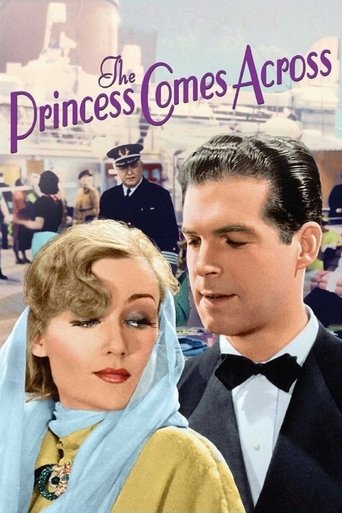
The Princess Comes Across (1936)
Those rollicking STARS of "HANDS ACROSS THE TABLE"
A Swedish princess boards an ocean liner in Europe en route to an acting career in America and finds herself getting inconveniently attached to a bandleader returning home. To complicate matters, a blackmailer on board apparently knows she is not who she claims to be - and he has his sights set on other passengers with secrets of their own. In the meantime an escaped killer has stowed away under someone else's identity, and is killing again to cover his tracks; five international police detectives on board are heading the investigation to find him. When evidence points to the princess and bandleader, they must find the killer themselves - before he finds them.
- Date of release
- 1936-05-22
- TMDB
- 6.2 / 10 (19)
- Runtime
- 1h 16m
- Genres
- Comedy, Romance, Mystery, Thriller
- Director
- William K. Howard
Casting
- Carole Lombard — Princess Olga / Wanda Nash
- Fred MacMurray — King Mantell
- Douglass Dumbrille — Lorel
- Alison Skipworth — Lady Gertrude
- George Barbier — Captain Nicholls
- William Frawley — Benton
- Porter Hall — Darcy
- Lumsden Hare — Cragg
- Sig Ruman — Steindorf
- Mischa Auer — Morevitch
- Bradley Page — The Stranger
- Tetsu Komai — Kawati
Interesting facts
The Princess Comes Across is a 1936 American mystery comedy film directed by William K. Howard and starring Carole Lombard and Fred MacMurray, the second of the four times they were paired together. Lombard, playing an actress from Brooklyn pretending to be a Swedish princess, does a "film-length takeoff" on MGM's Swedish star Greta Garbo. The film was based on the 1935 novel A Halálkabin by Louis Lucien Rogger, the pseudonym of Laszlo Aigner and Louis Acze.
Production
The Princess Comes Across – which began with the working title Concertina – was initially intended to pair Lombard with George Raft for the third time, but Raft walked out when the studio assigned Ted Tetzlaff to photograph the film. Raft felt that Tetzlaff had made Lombard look better than himself in their earlier film, Rumba, and did not want it to happen again. It was one of many roles Raft rejected after becoming a star.
With Raft out of the picture, and temporarily suspended for his actions, the studio re-teamed Lombard and MacMurray, who had made the screwball comedy Hands Across the Table together in 1935. They would be paired together twice more, in 1937's Swing High, Swing Low and True Confession, made in the same year.
Aside from casting concerns, filming was also delayed by the need for additional dialogue, which caused a change of directors from Harold Young to William K. Howard, and, after filming had begun in February 1936, by conflict between Howard and the producer's assistant.
Read on Wikipedia · Text from Wikipedia, CC BY-SA 4.0. Data from Wikidata.
Recommended
- Song of the Thin Man 1947 · ★ 6.7
- The Mirror Crack'd 1980 · ★ 6.1
- It's a Wonderful World 1939 · ★ 6.6
- Deathtrap 1982 · ★ 6.7
- Shadow of the Thin Man 1941 · ★ 7.0
- Lady on a Train 1945 · ★ 6.6
- Another Thin Man 1939 · ★ 7.1
- Black Angel 1946 · ★ 6.1
- Scooby-Doo! Music of the Vampire 2012 · ★ 7.6
- Who Done It? 1942 · ★ 6.9
- A Blueprint for Murder 1953 · ★ 6.2
- The Mad Miss Manton 1938 · ★ 6.4