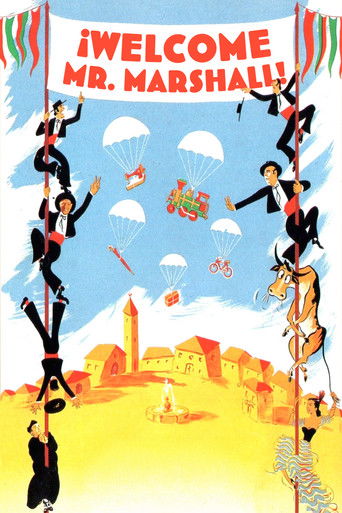
Welcome Mr. Marshall! (1953)
¡Bienvenido, Mister Marshall!
A small Spanish town, Villar del Río, is alerted to the upcoming visit of American diplomats and its ruling townsmen begin preparations to impress the American visitors, in the hopes of benefiting under the Marshall Plan. Hoping to demonstrate the side of Spanish culture with which the visiting foreign officials would be more familiarized, the Castilian citizens don unfamiliar Andalusian costumes, hire a renowned flamenco performer, and re-decorate their town in Andalusian style, meantime waiting for their uncertain arrival.
- Date of release
- 1953-04-04
- TMDB
- 7.4 / 10 (128)
- Runtime
- 1h 18m
- Genres
- Comedy
- Director
- Luis García Berlanga
Casting
- José Isbert — Don Pablo, el alcalde
- Manolo Morán — Manolo
- Lolita Sevilla — Carmen Vargas
- Alberto Romea — Don Luis, el caballero
- Elvira Quintillá — Señorita Eloísa, la maestra
- Luis Pérez de León — Don Cosme, el cura
- Félix Fernández — Don Emiliano, el médico
- Nicolás D. Perchicot — Boticario
- Fernando Aguirre — Geronimo - el secretario
- Emilio Santiago — Barbero (uncredited)
- Joaquín Roa — Julían - el pregonero
- José Franco — Delegado general
Interesting facts
Welcome Mr. Marshall! is a 1953 Spanish satirical absurdist comedy film directed by Luis García Berlanga, and considered one of the masterpieces of Spanish cinema. The film highlights the stereotypes held by both the Spanish and the Americans regarding the culture of the other, as well as displays social criticism of 1950s Francoist Spain. The film was entered into the 1953 Cannes Film Festival. It was the first full-length film Berlanga directed alone.
Production
Initially, Berlanga was commissioned to make a film to serve as a vehicle for the budding flamenco singer Lolita Sevilla, but Berlanga decided to give the film a deeper, more satirical meaning. In creating Welcome Mr. Marshall!, Berlanga publicly claimed to offer a human picture of what the Spanish peasant, interested more in crops than in politics, might feel about the American people and their role in the post-war world.
Berlanga chose to film in the small village of Guadalix de la Sierra, fifty miles north of Madrid. Villagers were cast as themselves, taking all but the principal roles and changing many of the scenes. During the scene in which townspeople lined up to state their hearts' desires, they ignored the script and asked for what they actually wanted.
Shooting lasted ten weeks with a production budget of $70,000 ($780,000 in 2022 dollars).
Read on Wikipedia · Text from Wikipedia, CC BY-SA 4.0. Data from Wikidata.
Recommended
- Blazing Saddles 1974 · ★ 7.2
- The Mouse That Roared 1959 · ★ 6.4
- The Ladykillers 1955 · ★ 7.3
- Way Out West 1937 · ★ 7.1
- Ruggles of Red Gap 1935 · ★ 7.1
- Duck Soup 1933 · ★ 7.3
- Family Plot 1976 · ★ 6.8
- Homo Argentum 2025 · ★ 6.1
- Dawn Breaks, Which Is No Small Thing 1989 · ★ 7.2
- Carry On Dick 1974 · ★ 5.8
- Fun with Dick and Jane 1977 · ★ 6.6
- Mr. Bones 2001 · ★ 6.0