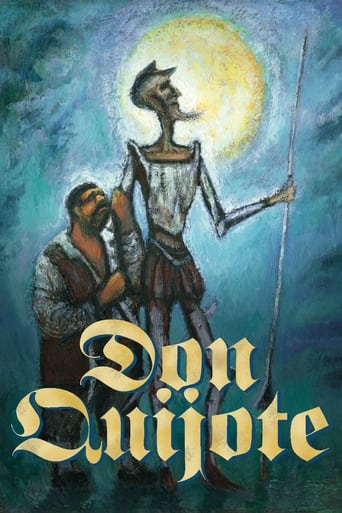
Don Quixote (1992)
Don Quijote de Orson Welles
One man scorned and covered with scars still strove with his last ounce of courage to reach the unreachable stars and the world will be better for this.
A posthumous 1992 reconstruction of Orson Welles’s long-unfinished Don Quixote project, edited by Jesús Franco from footage shot between 1957 and 1972, following Don Quixote and Sancho Panza as they wander modern Spain in pursuit of chivalric ideals. (Note: This version represents a later editorial assembly, not a film completed by Welles.)
- Date of release
- 1992-04-20
- TMDB
- 6.2 / 10 (33)
- Runtime
- 1h 56m
- Genres
- Adventure, Drama, Comedy
- Director
- Orson Welles
Casting
- Francisco Reiguera — Don Quijote
- Akim Tamiroff — Sancho Panza
- Orson Welles — Self
- Pepe Mediavilla — Don Quijote (voice)
- Juan Carlos Ordóñez — Sancho Panza (voice)
- Constantino Romero — Narrator (voice)
- Paola Mori — Woman on Motorscooter (archive footage)
- Juan Serrano — (archive footage)
- Beatrice Welles — (archive footage)
- Oja Kodar — (archive footage)
- Fernando Rey — Closing Scene Narrator (voice) (uncredited)
Interesting facts
- Based on: Don Quixote
Don Quixote is an unfinished film project written, co-produced and directed by Orson Welles. Principal photography took place between 1957 and 1969. Test footage was filmed as early as 1955, second-unit photography was done as late as 1972, and Welles was working on the film intermittently until his death in 1985. The film was eventually edited by Jesús Franco and was released in 1992, to mixed reviews.
Production
On June 29, 1957, after having been removed from his own film Touch of Evil, Welles headed to Mexico City to begin work on the feature-length version of Don Quixote. The part of Don Quixote had been offered to Charlton Heston, who had just finished filming Touch of Evil with Welles, and Heston was keen on playing the role, but was only available for two weeks, which Welles feared would be insufficient.
Welles worked without a finished script, shooting improvised sequences on the street. Much of the footage was shot with silent 16 mm equipment, with Welles planning to dub the dialogue at a later date. As the production evolved, Welles told film critic André Bazin that he saw his Don Quixote being created in the improvisational style of silent comedy films. The bulk of filming occurred in Mexico in two blocks in late 1957.
However, Welles's production was forced to stop due to problems with financing. At this stage the project was supervised by Mexican producer Oscar Dancigers, and after Welles went over budget by some $5,000, Dancigers suspended filming, before pulling out of the project entirely. Thereafter, Welles produced the film himself. Welles became preoccupied with other projects, including attempts to salvage Touch of Evil.
During the 1960s, Welles shot fragments of Don Quixote in Spain (Pamplona, Málaga and Seville) and Italy (Rome, Manziana and Civitavecchia) as his schedule and finances allowed; he even found time to film sequences (reported as being "the prologue and epilogue") while on vacation in Málaga commuting all the while to Paris to oversee the post-production work on his 1962 adaptation of The Trial.
The production became so prolonged that Reiguera, who was seriously ailing by the end of the 1960s, asked Welles to finish shooting his scenes before his health gave out. Welles was able to complete the scenes involving Reiguera prior to the actor's death in 1969. However, as Welles shot most of the footage silently, he seldom filmed the original actors' dialogue.
Read on Wikipedia · Text from Wikipedia, CC BY-SA 4.0. Data from Wikidata.
Recommended
- Don Quixote 2000 · ★ 6.3
- The Man Who Killed Don Quixote 2018 · ★ 6.7
- Pinocchio 2009 · ★ 6.1
- Dear Eleanor 2016 · ★ 5.9
- Arctic Dogs 2019 · ★ 5.9
- The Willoughbys 2020 · ★ 7.0
- Slumberland 2022 · ★ 7.2
- Strings 2004 · ★ 6.6
- The Four Musketeers 1974 · ★ 6.5
- To Grandmother's House We Go 1992 · ★ 6.5
- Chickenhare and the Hamster of Darkness 2022 · ★ 7.2
- The Fox and the Hound 2 2006 · ★ 6.0