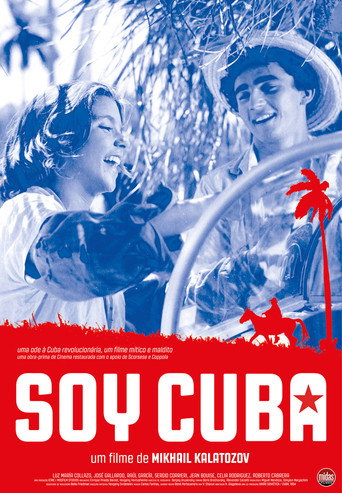
Soy Cuba (1964)
Retrato dos contrastes da sociedade cubana no período imediatamente anterior à Revolução de 1959, acompanha várias histórias: uma jovem fascinada pelo luxo de um casino gerido por norte-americanos afasta-se do namorado que é vendedor ambulante; um rendeiro revolta-se da única forma que conhece, atacando a terra que cultiva; um grupo de universitários é confrontado com a agitação política; e, nas colinas em redor de Havana, uma família de camponeses pobres adere ao movimento revolucionário.
- Data de estreia
- 1964-10-26
- TMDB
- 7.9 / 10 (267)
- Duração
- 2 h 21 min
- Géneros
- Drama
- Realizador
- მიხეილ კალატოზიშვილი
Elenco
- Sergio Corrieri — Alberto
- Salvador Wood — Mariano
- José Gallardo — Pedro
- Raúl García — Enrique
- Luz María Collazo — Maria / Betty
- Jean Bouise — Jim
- Alberto Morgan — Ángel
- Fausto Mirabal
- Roberto García York — American Activist
- María de las Mercedes Díez
- Bárbara Domínguez
- Jesús del Monte
Curiosidades
- Bilheteira: US$ 274,1 mil
I Am Cuba is a 1964 political drama anthology film directed by Mikhail Kalatozov. An international co-production between the Soviet Union and Cuba, it follows four distinct stories about the Cuban population shortly before the Revolution.
Production
Shortly after the 1959 Cuban Revolution overthrew the United States-backed dictatorship of Fulgencio Batista, the socialist Castro government, isolated by the United States after the latter broke diplomatic and trade relations in 1961, turned to the USSR in many areas, including for film partnerships.
The director was given considerable freedom to complete the work, and was given much help from both the Soviet and Cuban governments. Among his inspirations for the project was Sergei Eisenstein's unfinished ¡Que viva México!, another Soviet project about a post-revolutionary Latin American nation. Among Kalatozov's Cuban collaborators on the project were screenwriter Enrique Pineda Barnet and composer Carlos Fariñas.
The film made use of many innovative techniques, such as coating a watertight camera's lens with a special submarine periscope cleaner, so the camera could be submerged and lifted out of the water without any drops on the lens or film. At one point, more than 1,000 Cuban soldiers were moved to a remote location to shoot one scene.
In another scene, the camera follows a flag over a body, held high on a stretcher, along a crowded street. Then it stops and slowly moves upwards for at least four storeys until it is filming the flagged body from above a building. Without stopping, it then starts tracking sideways and enters through a window into a cigar factory, then goes straight towards a rear window where the cigar workers are watching the procession.
Ler na Wikipédia · Texto da Wikipédia, CC BY-SA 4.0. Dados do Wikidata.
Recomendados
- Che - O Argentino 2008 · ★ 6.8
- Diários de Che Guevara 2004 · ★ 7.4
- O Triunfo dos Porcos 1954 · ★ 7.1
- Fireflies at El Mozote 2025 · ★ 8.7
- Pesadelo na Rua Carroll 1988 · ★ 5.9
- A Costa do Mosquito 1986 · ★ 6.4
- The Old Man and the Sea 1958 · ★ 6.5
- Aqui 2024 · ★ 6.5
- A Grande Ilusão 2013 · ★ 6.0
- Among Wolves 2010 · ★ 6.2
- A Translator 2019 · ★ 6.8
- Utama 2022 · ★ 7.2