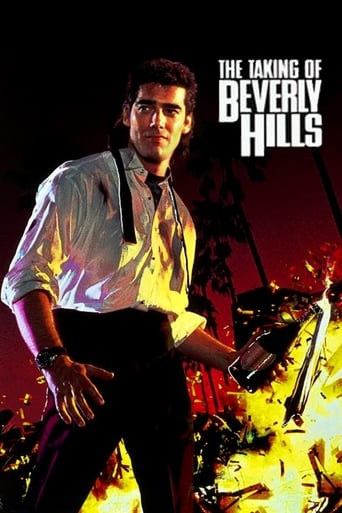
The Taking of Beverly Hills (1991)
The richest city in the world. Shut down. Ripped off. Blown up.
A chemical spill has caused the occupants of Beverly Hills to be forcibly evacuated. A retiring football player left behind, finds that the toxic gas emulating from the spill is a bogus front for a heist set up by fired police officers out to plunder the city of all its valuables. Finding himself siding with a corrupt cop who was once apart of the plan until he discovered the city's mayor had just been blown away, by one of the chief crooks in charge. Now both on the run with no help in sight...both must do whatever they can to stop these murderous looters.
- Date of release
- 1991-10-10
- TMDB
- 5.2 / 10 (45)
- Runtime
- 1h 36m
- Genres
- Action
- Director
- Sidney J. Furie
Casting
- Ken Wahl — Boomer Hayes
- Matt Frewer — Ed Kelvin
- Harley Jane Kozak — Laura Sage
- Robert Davi — Robert Masterson
- Lee Ving — Varney
- Branscombe Richmond — Benitez
- Lyman Ward — Chief Healy
- Michael Bowen — L.A. Cop at Roadblock
- William Prince — Mitchell Sage
- Michael G. Kehoe — Cop / Thief #1
- Mark Haining — Cop / Thief #2
- Jason Blicker — Cop / Thief #3
Interesting facts
- Box office: $939.3K
- Budget: $19M
- Earned 0× its budget
The Taking of Beverly Hills is a 1991 American action film directed by Sidney J. Furie and starring Ken Wahl, Matt Frewer, Harley Jane Kozak and Robert Davi. The story follows football star "Boomer" Hayes (Wahl), as he battles ex-cops using a chemical spill as a front to plunder Beverly Hills' riches, with the help of a remorseful officer (Frewer) who came close to siding with the bandits. A then little known Pamela Anderson makes a brief, uncredited appearance.
Production
The initial premise came from director Sidney J. Furie. He took it to David Fuller, writer of his films The Boys in Company C and Purple Hearts, who teamed up with longtime friend Rick Natkin. Furie sent the completed script to Purple Hearts star Ken Wahl midway into the second season of his TV series Wiseguy.
Wahl was paid $750,000 for the role, the first in a planned three-picture deal with Nelson Entertainment, a British-owned upstart that was easing into a lead producer role, following their success with more minor investments, like Bill and Ted's Excellent Adventure. Wahl's good friend Tony Ganios soon joined the cast, tentatively as a villain named Megadeath, although rewrites were still ongoing and he had to settle for another role.
David Giler was announced as the film's producer, but he is not credited in the final picture. The eventual producer, Graham Henderson, was the vice-president in charge of production at Nelson. Although uncredited in either capacity, Wahl was identified as co-producer in some sources, an as executive producer in others.
From the onset, it was clear that the city of Beverly Hills could not, and would not, accommodate such a venture. Peter Lamont spent three months mapping out the real Rodeo Drive in pictures, which attracted the suspicion of some jewelry stores. The area was then recreated on the grounds of the Ciudad deportiva (lit. 'Sports City'), an unfinished sports complex just south of Mexico City. Building started in December 1989.
Principal photography took place between April 2 and July 6, 1990, during the third Wiseguy offseason, as it was not yet known that Wahl would leave the show. Nelson used a subsidiary called Elm Productions for the shoot. Wahl's number 12 jersey was a nod to Joe Namath. For Kozak, costume designer Betsy Cox chose a cocktail dress by Jean Paul Gaultier.
Read on Wikipedia · Text from Wikipedia, CC BY-SA 4.0. Data from Wikidata.
Recommended
- The Marine 5: Battleground 2017 · ★ 6.6
- Lights Out 2024 · ★ 7.0
- Chief of Station 2024 · ★ 6.3
- King of Killers 2023 · ★ 6.2
- Off the Grid 2025 · ★ 6.5
- Beckman 2020 · ★ 6.1
- One Ranger 2023 · ★ 6.4
- Trap House 2025 · ★ 6.6
- The Specialist 1994 · ★ 6.0
- Infiltrate 2026 · ★ 7.3
- Point Blank 2019 · ★ 6.0
- Fast Charlie 2023 · ★ 6.3