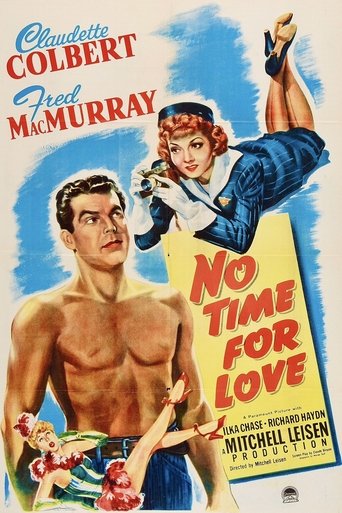
No Time for Love (1943)
An upper-class female reporter is (despite herself) attracted to a hulking laborer digging a tunnel under the Hudson River.
- Data lansării
- 1943-04-09
- TMDB
- 7.0 / 10 (22)
- Durată
- 1 h 23 min
- Genuri
- Comedie, Romantic
- Regizor
- Mitchell Leisen
Distribuție
- Claudette Colbert — Katherine Grant
- Fred MacMurray — Jim Ryan
- Ilka Chase — Hoppy Grant
- Richard Haydn — Roger Winant
- Paul McGrath — Henry Fulton
- June Havoc — Darlene
- Marjorie Gateson — Sophie
- Woody Strode — Black Sandhog (uncredited)
- Murray Alper — Moran (uncredited)
- Faith Brook — Pert Brunette (uncredited)
- Rod Cameron — Taylor (uncredited)
- Kenneth Chryst — Photographer (uncredited)
Curiozități
- Premii: 0 · Nominalizări: 1
No Time for Love is a 1943 American screwball comedy film produced and directed by Mitchell Leisen and starring Claudette Colbert and Fred MacMurray. Written by Claude Binyon, Robert Lees, and Frederic I. Rinaldo, the film is about a sophisticated female photographer assigned to photograph the tough "sandhog" construction workers at a tunnel project site. After saving one of the sandhogs from a fatal accident, she becomes attracted to this cocky well-built man they call Superman. Unsettled by her feelings, she hires the man as her assistant, believing that her attraction to him will diminish if she spends time with him.
Production
The screenplay for No Time for Love was written by Claude Binyon, based on a story by Robert Lees and Frederic I. Rinaldo. The Katherine Grant character is based on Margaret Bourke-White, Life magazine's first female photojournalist, whose stylized photos of industrial subjects were featured in Life's premiere issue, initiating a new era of photojournalism.
Oscar Levant was originally cast for the role of Roger, but when filming was delayed he was forced to withdraw due to other commitments. Rita Hayworth was originally cast as Katherine, but also had to withdraw when production was delayed by eighteen months.
Claudette Colbert and Fred MacMurray were finally cast in the lead roles. They co-starred together in seven films between 1935 and 1948. No Time for Love was their fourth film together. Both actors had worked with director Mitchell Leisen on a number of other films—MacMurray made a total of nine films with him, and Colbert four. Colbert also worked with Leisen when he was a costume designer on Cecil B.
Fred and Claudette worked so wonderfully together. Many times when I was setting up the next scene, they'd go off in a corner and work it up themselves. They'd show me how they wanted to do it and it would be just right ... they were talented natural performers and I wanted them to do it in a way that was comfortable for them.
Due to the restricted use of film stock during the war years, the actors rehearsed extensively throughout the filming to avoid multiple takes. Many of the scenes that ended up in the film were first takes.
Citește pe Wikipedia · Text din Wikipedia, CC BY-SA 4.0. Date din Wikidata.
Recomandate
- Poveste din Philadelphia 1940 · ★ 7.5
- Eu și prințul 4: Vizita regală 2010 · ★ 6.1
- Platinum Blonde 1931 · ★ 6.6
- Fiorii celebrității 1963 · ★ 7.0
- S-a întâmplat într-o noapte 1934 · ★ 7.8
- That Uncertain Feeling 1941 · ★ 6.6
- Watching the Detectives 2007 · ★ 6.3
- Iubire, nunți și alte dezastre 2020 · ★ 6.0
- Teacher's Pet 1958 · ★ 6.8
- Desk Set 1957 · ★ 7.0
- The Baxter 2005 · ★ 6.0
- Crăciunul cu tine 2022 · ★ 5.8