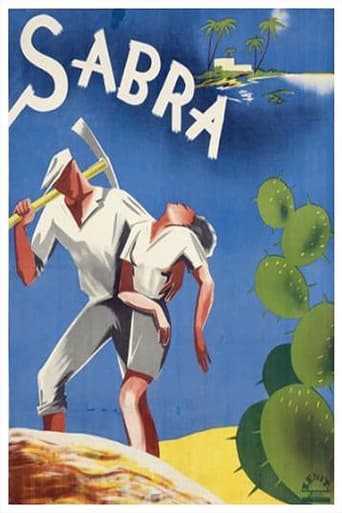
Sabra (1933)
Describe the harsh reality attempts of establishing a Jewish settlement in Israel and the efforts of the Arab to prevent it. The film is considered as the first talking film in Palestine Israel.
- Data de estreia
- 1933-01-02
- TMDB
- 7.0 / 10 (1)
- Duração
- 1 h 24 min
- Géneros
- Drama
- Realizador
- Aleksander Ford
Elenco
Curiosidades
Sabra is a 1933 Polish black-and-white drama film directed by Aleksander Ford, based on a screenplay by Ford and Olga Fordowa. The film depicts the struggles of a group of Jewish pioneers immigrating from Poland to Mandatory Palestine, where they establish a settlement. Their complex relationship with local Arab residents forms the backdrop for a romantic subplot involving an Arab girl and a Jewish boy.
Production
Following the success of Legion ulicy (1932), Aleksander Ford sought to continue exploring social issues. Inspired by the Soviet film Road to Life (1931) by Nikolai Ekk, he planned a film on juvenile delinquency and rehabilitation, scripted by Andrzej Wolica for Leo-Film. The project was abandoned. Instead, Ford accepted Władysław Markiewicz's proposal to create a film about pioneers in Mandatory Palestine.
Ford, Olga Fordowa, and cinematographer Franz Weihmayr arrived in the Middle East without a screenplay. They traveled extensively, studying local communities, customs, and tensions, filming events like the Muslim Nabi Musa festival covertly, at personal risk, after signing a waiver with Mandate authorities.
As a committed communist, Ford was skeptical of Zionism, dismissing it as misguided, and declined offers to stay in Palestine to develop its film industry or work in theatre. Actor Szymon Finkel recalled: "Ford was a serious young man, ambitious, striving for perfection. He was left-leaning, or ‘somewhat left-leaning', as we said then, and wanted to return to Poland despite job offers here.
Ford's research shaped Sabra, named after the term for Jews born in Palestine and a type of prickly pear cactus. Drawing on Legion ulicy, he prioritized setting over narrative, blending authentic, unstaged footage with scripted scenes for a "dramatized report" effect. He cast professional actors from the Habima Theatre alongside local non-actors, filming in real locations like the desert and interiors, primarily in Gedera.
Rejecting Zionism, Ford downplayed the settlers' Jewish identity, portraying them as European workers, primarily Polish-speaking, with minimal Yiddish. He avoided framing the conflict as nationalistic, instead emphasizing class solidarity, inspired by Soviet cinema. The pioneers and poor Arabs are depicted as equals, reliant on the wealthy sheikh for resources like water and land.
Ler na Wikipédia · Texto da Wikipédia, CC BY-SA 4.0. Dados do Wikidata.
Recomendados
- Skin 2009 · ★ 6.4
- Gracie 2007 · ★ 6.2
- Farming 2018 · ★ 6.2
- Girl in the Box 2016 · ★ 6.7
- A Jovem 1960 · ★ 7.0
- Bastard Out of Carolina 1996 · ★ 7.1
- Árvores da Paz 2021 · ★ 7.2
- O Rio 1984 · ★ 6.4
- The Scar 1976 · ★ 6.6
- Adam 2020 · ★ 6.3
- Holy Lands 2019 · ★ 6.1
- The Wedding Day 2021 · ★ 6.0