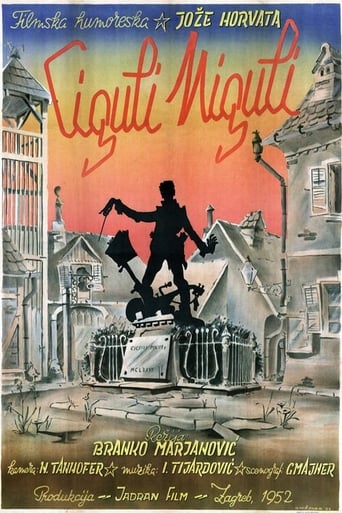
Ciguli Miguli (1952)
Ivan Ivanović, a party functionary, arrives in a provincial town as a temporary replacement for a cultural official. The newcomer is fanatically eager to reform the town's cultural life in accordance with socialist ideals. He abolishes all five music societies and orders a monument of the town's most revered native, late composer Ciguli Miguli, removed from the main square. Ivanović's actions, however, meet stiff resistance from the townspeople, especially the youth.
- Date of release
- 1952-01-01
- TMDB
- 6.0 / 10 (4)
- Runtime
- 1h 44m
- Genres
- Comedy, Drama, Romance
- Director
- Branko Marjanović
Casting
- Ljubomir Didić — Ivan Ivanović
- Avgust Čilić — Valetin Žugec, gostioničar
- Viktor Bek — Pepek
- Martin Matošević — Šef vatrogasnog društva
- Zvonko Tkalec — Pak Hrdalo
- Ljubo Dijan — Krojač
- Joža Šeb — Hijacint Štiglic, brijač
- Milivoj Arhanić — Ivek
- Boris Buzančić — Predsjednik omladinskog saveza
- Josip Daneš
- Mira Gavrilović
- Zdenka Heršak
Interesting facts
Ciguli Miguli is a 1952 Yugoslav political satire film directed by Branko Marjanović and written by Joža Horvat. It was meant to be the first satirical film of the post-World War II Yugoslav cinema, but its sharp criticism of bureaucracy was politically condemned by the authorities and the film was banned as "anti-socialist".
Background and production
Prior to Ciguli Miguli, director Branko Marjanović and writer Joža Horvat had collaborated on Zastava (1949), a socialist realist war film that won several awards. This time, however, Horvat wanted something different, hoping that a satire of Soviet-type bureaucracy would mesh with the wave of liberalization of cultural life in Yugoslavia set in motion by Tito's breakup with Stalin in 1948.
Marjanović took over Ciguli Miguli only after his proposal for Nikola Tesla, a biography of the famous engineer and inventor, had been rejected by Jadran Film. As a non-party intellectual, he was not an ideal choice for directing a politically risky film, but it was believed that Joža Horvat's impeccable reputation and his good standing with the authorities would be sufficient.
Ciguli Miguli was a significantly more complex project than Zastava, but the shooting - which began in August 1951 - was finished in six months. That was considered normal for standards of Yugoslav cinema of the era, in contrast with chaotic and protracted shooting of Zastava that lasted for fifteen months.
Although Marjanović initially chose veteran filmmaker Oktavijan Miletić as a cinematographer, the two soon parted ways due to disagreements. Miletić was replaced with Nikola Tanhofer, cinematographer of Zastava, then still only 25 years old.
Read on Wikipedia · Text from Wikipedia, CC BY-SA 4.0. Data from Wikidata.
Recommended
- Numb 2007 · ★ 5.9
- Quartet 2012 · ★ 6.5
- Enemies, a Love Story 1989 · ★ 6.2
- The Best You Can 2025 · ★ 7.0
- Cyrus 2010 · ★ 5.9
- Delirious 2007 · ★ 6.3
- Breaking & Exiting 2018 · ★ 6.0
- Not Easily Broken 2009 · ★ 6.3
- Coyote Ugly 2000 · ★ 6.3
- He Said, She Said 1991 · ★ 5.9
- I Met a Girl 2020 · ★ 6.4
- (Untitled) 2009 · ★ 6.3