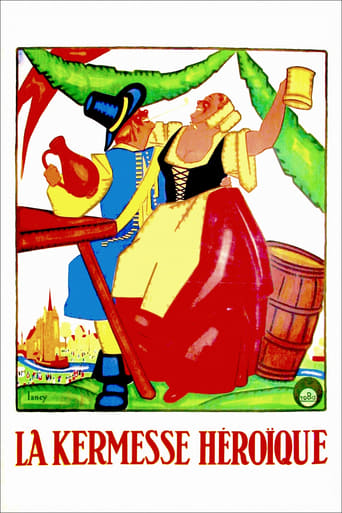
La Kermesse héroïque (1935)
Flanders, Hispanic Monarchy, 1616. The inhabitants of the small town of Boom are busy organizing the annual local festivities when the arrival of the Duke of Olivares, who rules the country on behalf of the King Philip III of Spain, is announced. While the male citizens cowardly surrender to panic like rats on a sinking ship, the brave female citizens, led by the bold wife of the burgomaster, decide to become the best hosts the Spaniards can ever meet.
- Data de estreia
- 1935-12-03
- TMDB
- 7.4 / 10 (55)
- Duração
- 1 h 50 min
- Géneros
- Comédia, História, Romance
- Realizador
- Jacques Feyder
Elenco
- Françoise Rosay — Madame Burgomaster
- Jean Murat — The Duke of Olivares
- André Alerme — The Burgomaster
- Lyne Clevers — The Fishmonger
- Micheline Cheirel — Siska
- Maryse Wendling — The Baker
- Ginette Gaubert — The Innkeeper
- Marguerite Ducouret — The Brewer
- Louis Jouvet — The Priest
- Bernard Lancret — Julien Breughel
- Alfred Adam — The Butcher
- Pierre Labry — The Innkeeper
Curiosidades
- Filmado em: Bruges e Paris
Carnival in Flanders is a 1935 French historical romantic comedy film directed by Jacques Feyder, and created during the poetic realism period in 1930s France. It is also widely known under its original title in French, La Kermesse héroïque. A German-language version of the film was made simultaneously and was released under the title Die klugen Frauen, featuring Ernst Schiffner in one of his early film roles.
Production design
Production designer Lazare Meerson was put in charge of creating the setting for the film. He had to bring Feyder's vision to life, a challenging task for a story set several hundred years prior to the time of production. Meerson took care in building the set from scratch, and, as The National Board of Review Magazine notes, he was able to elegantly contrive an atmosphere true to 17th century Flanders.
The scale and detail of the set was achieved by Feyder and Meerson’s insistence to their German financial backers, which led them to dig a canal through the center of the Epinay Studios. The Flemish town was created around the canal in the architectural styles of the age depicted, providing the stylized depth which was Meerson’s trademark.
Ler na Wikipédia · Texto da Wikipédia, CC BY-SA 4.0. Dados do Wikidata.
Recomendados
- A Mania das Grandezas 1971 · ★ 7.4
- A Volta ao Mundo em Oitenta Dias 1956 · ★ 6.7
- Cinderela Pop 2019 · ★ 6.5
- A Vida Pode Mudar 2021 · ★ 6.1
- Speechless 1994 · ★ 6.0
- The Pirates of Penzance 1983 · ★ 6.0
- Falling for Christmas 2022 · ★ 6.2
- Um Plano Perfeito 2012 · ★ 5.9
- O Diário da Princesa 2001 · ★ 7.0
- A Midsummer Night's Dream 1999 · ★ 6.4
- Angélica, a Marquesa dos Anjos 1964 · ★ 6.7
- Boot Camp 2024 · ★ 6.1