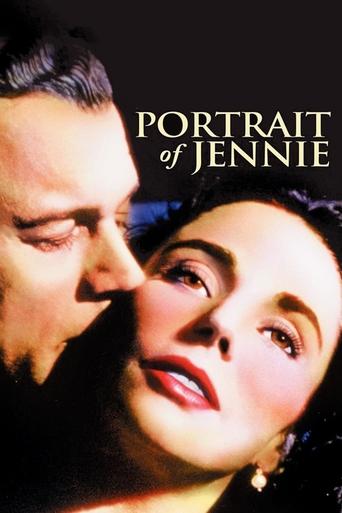
Portrait of Jennie (1948)
The screen's most romantic team!
In Depression-era New York, painter Eben Adams despairs at his lack of success. One cold winter evening in Central Park, he meets enigmatic, old-fashioned Jennie Appleton, who captures his fancy when she asks him to wait for her to grow up. Soon after, Eben sells a sketch of Jennie to kindly art dealer Miss Spinny and, as he meets the oddly mutable Jennie in fleeting moments, begins to realize they share a special destiny.
- Date of release
- 1948-12-25
- TMDB
- 7.2 / 10 (128)
- Runtime
- 1h 26m
- Genres
- Drama, Romance, Fantasy, Mystery
- Director
- William Dieterle
Casting
- Jennifer Jones — Jennie Appleton
- Joseph Cotten — Eben Adams
- Ethel Barrymore — Miss Spinney
- Lillian Gish — Mother Mary of Mercy
- Cecil Kellaway — Matthews
- David Wayne — Gus O'Toole
- Florence Bates — Mrs. Jekes
- Albert Sharpe — Moore
- Henry Hull — Eke
- Felix Bressart — Pete
- Clem Bevans — Capt. Cobb
- Maude Simmons — Clara Morgan
Interesting facts
- Based on: Portrait of Jennie
- Filmed in: New York City
- Awards: 1 · Nominations: 2. Including: Academy Award for Best Special Effects
Portrait of Jennie is a 1948 American supernatural film directed by William Dieterle, produced by David O. Selznick, and starring Jennifer Jones, Joseph Cotten, Ethel Barrymore, and Lillian Gish. Its plot follows an impoverished New York City painter whose chance encounter with an old-fashioned young woman in Central Park changes the course of his life. It is based on the 1940 novella of the same name by Robert Nathan.
Production
The book on which the film was based first attracted the attention of David O. Selznick, who purchased it as a vehicle for Jennifer Jones.
Filming began in early 1947 in New York City and Boston, Massachusetts, but Selznick was unhappy with the results and scheduled re-shoots as well as hiring and firing five different writers before the film was completed in October 1948. The budget for the production ultimately reached $4,041,000.
The New York shooting enabled Selznick to use Albert Sharpe and David Wayne, who were both appearing on stage in Finian's Rainbow, giving an Irish flair to characters and the painting in the bar that was not in Nathan's novel.
Although Portrait of Jennie was a fantasy, Selznick insisted on filming actual locations in Massachusetts (The Graves Light) and New York City (Central Park, The Cloisters and the Metropolitan Museum of Art), which dramatically increased the film's production costs. The film's major overhaul came when Selznick added a tinted color sequence for the final scenes.
Portrait of Jennie was highly unusual for its time in that it had no opening credits as such, except for the Selznick Studio logo. All the other credits appear at the end. Before the film proper begins, the title is announced by the narrator (after delivering a spoken prologue, he says, "And now, 'Portrait of Jennie'").
Read on Wikipedia · Text from Wikipedia, CC BY-SA 4.0. Data from Wikidata.
Recommended
- Winter's Tale 2014 · ★ 6.3
- Christmas Cottage 2008 · ★ 6.3
- Remarkably Bright Creatures 2026 · ★ 8.3
- The Eternal Daughter 2022 · ★ 5.9
- The Ghost and Mrs. Muir 1947 · ★ 7.5
- Really Love 2020 · ★ 6.2
- The Caveman's Valentine 2001 · ★ 5.9
- Possession 2002 · ★ 6.0
- The Good Witch 2008 · ★ 7.1
- Mr. K 2025 · ★ 6.2
- Laura 1944 · ★ 7.6
- Impact 1949 · ★ 6.1