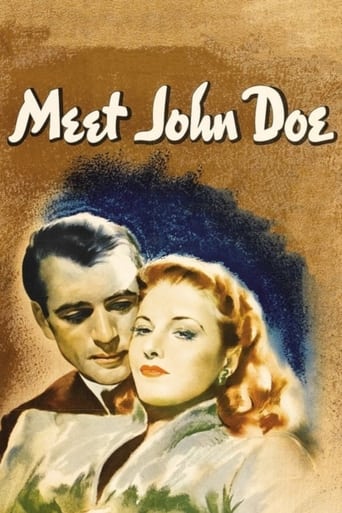
Meet John Doe (1941)
All America wants to meet the “Mr. Deeds” of 1941!
As a parting shot, fired reporter Ann Mitchell prints a fake letter from unemployed "John Doe," who threatens suicide in protest of social ills. The paper is forced to rehire Ann and hires John Willoughby to impersonate "Doe." Ann and her bosses cynically milk the story for all it's worth, until the made-up "John Doe" philosophy starts a whole political movement.
- Date of release
- 1941-03-14
- TMDB
- 7.3 / 10 (294)
- Runtime
- 2h 3m
- Genres
- Drama, Comedy, Romance
- Director
- Frank Capra
Casting
- Gary Cooper — Long John Willoughby
- Barbara Stanwyck — Ann Mitchell
- Edward Arnold — D.B. Norton
- Walter Brennan — The Colonel
- Spring Byington — Mme Mitchell
- James Gleason — Henry Connell
- Gene Lockhart — Mayor Lovett
- Rod La Rocque — Ted Sheldon
- Irving Bacon — Beany
- Regis Toomey — Bert Hansen
- J. Farrell MacDonald — 'Sourpuss'
- Warren Hymer — Angelface
Interesting facts
- Awards: 0 · Nominations: 1
Meet John Doe is a 1941 American comedy-drama film directed and produced by Frank Capra, written by Robert Riskin, and starring Gary Cooper, Barbara Stanwyck, Edward Arnold, Walter Brennan, Spring Byington, James Gleason, and Gene Lockhart. The film is about a "grassroots" political campaign created unwittingly by a newspaper columnist with the involvement of a hired homeless man and pursued by the paper's wealthy owner.
Production
The film was screenwriter Robert Riskin's last collaboration with Capra. The screenplay was derived from a 1939 film treatment, titled "The Life and Death of John Doe", written by Richard Connell and Robert Presnell who would go on to be the recipients of the film's sole Academy Award nomination for Best Original Story. The treatment was based upon Connell's 1922 Century Magazine story titled "A Reputation".
Gary Cooper was always Frank Capra's first choice to play John Doe. Cooper had agreed to the part without reading a script for two reasons: He had enjoyed working with Capra on their earlier collaboration, Mr. Deeds Goes to Town (1936), and he wanted to work with Barbara Stanwyck. The role of the hardbitten news reporter, however, was initially offered to Ann Sheridan, but the first choice for the role had been turned down by Warner Bros.
Director Frank Capra later described the film's ending as one of its most challenging aspects. In an interview, he noted that multiple endings were attempted and that the final version was chosen as "the one we were least dissatisfied with." Capra suggested that the difficulty in concluding the story may have stemmed from structural issues earlier in the narrative, stating that if a film cannot be ended satisfactorily, "perhaps the construction s…
Despite these creative challenges, Capra remarked that the film was financially successful for him and co-writer Robert Riskin, as they independently financed and owned the production, allowing them to profit even though it was not among his biggest box-office hits.
The composer selected was frequent Capra collaborator Dimitri Tiomkin, who also did the scores for Capra's Lost Horizon, Mr. Smith Goes to Washington and It's a Wonderful Life. He later won two music Oscars for the non-Capra film High Noon.
Read on Wikipedia · Text from Wikipedia, CC BY-SA 4.0. Data from Wikidata.
Recommended
- The Last Word 2017 · ★ 6.6
- I Met a Girl 2020 · ★ 6.4
- Posthumous 2014 · ★ 6.0
- Chéri 2009 · ★ 6.1
- Drive Me Crazy 1999 · ★ 6.6
- You Will Meet a Tall Dark Stranger 2010 · ★ 5.9
- Purple Hearts 2022 · ★ 8.0
- Which Brings Me to You 2023 · ★ 6.3
- Coyote Ugly 2000 · ★ 6.3
- Quartet 2012 · ★ 6.5
- Blind 2017 · ★ 6.1
- An Ideal Husband 1999 · ★ 6.5