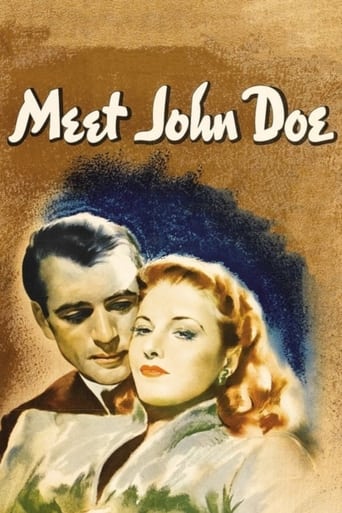
约翰·多伊 (1941)
Meet John Doe
全美都渴望一睹1941年的"迪兹先生"风采!
被解雇的报社女记者安·米歇尔伪造了一封信给报社,署名“约翰·杜伊”(即无名氏),信上表示对这个充满恶瘤的社会充满失望,决心要自杀。报社为此不得不重新聘用了安来调查此事。然而,没想到此事最终引发了一场政治运动……
演员阵容
- 加里·库珀 — Long John Willoughby
- 芭芭拉·斯坦威克 — Ann Mitchell
- 爱德华·阿诺德 — D.B. Norton
- 沃尔特·布伦南 — The Colonel
- Spring Byington — Mme Mitchell
- 詹姆斯·格里森 — Henry Connell
- 吉恩·洛克哈特 — Mayor Lovett
- Rod La Rocque — Ted Sheldon
- 欧文·培根 — Beany
- 里吉斯·图米 — Bert Hansen
- J. Farrell MacDonald — 'Sourpuss'
- Warren Hymer — Angelface
趣闻
- 获奖:0 · 提名:1
Meet John Doe is a 1941 American comedy-drama film directed and produced by Frank Capra, written by Robert Riskin, and starring Gary Cooper, Barbara Stanwyck, Edward Arnold, Walter Brennan, Spring Byington, James Gleason, and Gene Lockhart. The film is about a "grassroots" political campaign created unwittingly by a newspaper columnist with the involvement of a hired homeless man and pursued by the paper's wealthy owner.
Production
The film was screenwriter Robert Riskin's last collaboration with Capra. The screenplay was derived from a 1939 film treatment, titled "The Life and Death of John Doe", written by Richard Connell and Robert Presnell who would go on to be the recipients of the film's sole Academy Award nomination for Best Original Story. The treatment was based upon Connell's 1922 Century Magazine story titled "A Reputation".
Gary Cooper was always Frank Capra's first choice to play John Doe. Cooper had agreed to the part without reading a script for two reasons: He had enjoyed working with Capra on their earlier collaboration, Mr. Deeds Goes to Town (1936), and he wanted to work with Barbara Stanwyck. The role of the hardbitten news reporter, however, was initially offered to Ann Sheridan, but the first choice for the role had been turned down by Warner Bros.
Director Frank Capra later described the film's ending as one of its most challenging aspects. In an interview, he noted that multiple endings were attempted and that the final version was chosen as "the one we were least dissatisfied with." Capra suggested that the difficulty in concluding the story may have stemmed from structural issues earlier in the narrative, stating that if a film cannot be ended satisfactorily, "perhaps the construction s…
Despite these creative challenges, Capra remarked that the film was financially successful for him and co-writer Robert Riskin, as they independently financed and owned the production, allowing them to profit even though it was not among his biggest box-office hits.
The composer selected was frequent Capra collaborator Dimitri Tiomkin, who also did the scores for Capra's Lost Horizon, Mr. Smith Goes to Washington and It's a Wonderful Life. He later won two music Oscars for the non-Capra film High Noon.
在维基百科阅读更多 · 文本来自维基百科,CC BY-SA 4.0。数据来自 Wikidata。