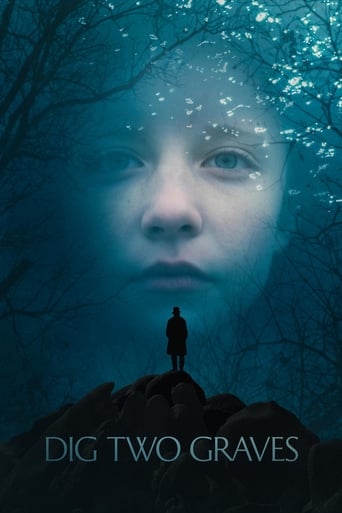
Dig Two Graves (2014)
A girl's obsession with her brother's disappearance leads her on a nightmarish journey through a small town's Gothic landscape where she is faced with a deadly proposition. How far will she go to save the people she loves?
- Date of release
- 2014-10-17
- TMDB
- 5.6 / 10 (100)
- Runtime
- 1h 25m
- Genres
- Mystery, Thriller, Fantasy, Horror
- Director
- Hunter Adams
Casting
- Ted Levine — Sheriff Waterhouse
- Samantha Isler — Jake Mather
- Danny Goldring — Proctor
- Troy Ruptash — Wyeth
- Rachael Drummond — Mrs. Waterhouse
- Bradley Grant Smith — Deputy Byron Freeman
- Mark Lancaster — Dee
- Mikush Lleshdedaj — Agimi Buchta
- Ann Sonneville — Shpresa Buchta
- Kara Zediker — Isabelle Mather
- Gabriel Cain — Willie Proctor
- Ben Schneider — Sean Mather
Interesting facts
Dig Two Graves is a 2014 independent gothic thriller written by Hunter Adams and Jeremy Phillips, and is Adams' first full-length feature as director. The film was executive produced by actor and director Larry Fessenden. Members of its crew were selected by the Independent Filmmaker Project, by working with the Southern Illinois University film department, and by involving the community of the film's Southern Illinois location. The film's cast includes Ted Levine, Samantha Isler, Danny Goldring, and Troy Ruptash.
Production
The film began as a short called Jake's Choice, filmed in northeast Wisconsin. The intention was for it to provide a fundraising tool, but as director Hunter Adams admitted to I Am Entertainment Magazine, it chiefly "helped [him] clarify the visual and aural design of the film".
In 2013, the Independent Filmmaker Project (IFP) selected the Dig Two Graves script as one of 20 in its Emerging Narrative Program. The IFP focuses exclusively on low-budget films (under $1 million) and provides first-time feature film directors with a free year-long mentorship that assists them and their crew with post-production, marketing, and distribution of their films.
Production took place over a total of five weeks: four weeks in January and one week in the summer. During filming, the cast endured one of Southern Illinois' worst winters in recorded history. However, producer P.J. Fishwick and associate producer Jon Parker, along with Adams, agreed that the area gave the film the visual look needed to maintain authenticity under a low-budget.
Read on Wikipedia · Text from Wikipedia, CC BY-SA 4.0. Data from Wikidata.
Recommended
- Nocebo 2022 · ★ 6.0
- Containment 2015 · ★ 5.9
- Older Gods 2023 · ★ 6.1
- Frank and Penelope 2022 · ★ 7.3
- The Unhealer 2021 · ★ 5.8
- God Is a Bullet 2023 · ★ 6.2
- All the Devils Are Here 2025 · ★ 6.2
- The Seven-Ups 1973 · ★ 6.4
- The Infernal Machine 2022 · ★ 6.2
- Blackwood 2014 · ★ 5.9
- Like Minds 2006 · ★ 6.4
- Cheat 2023 · ★ 7.1