India's Daughter (2015)
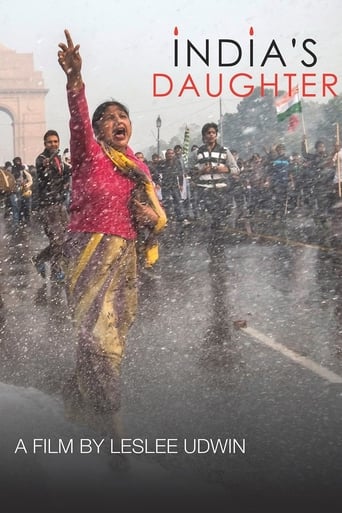
The story of the short life, and brutal gang rape and murder in Delhi in December 2012 of an exceptional and inspiring young woman. The rape of the 23 year old medical student by 6 men on a moving bus, and her death, sparked unprecedented protests and riots throughout India and led to the first glimmers of a change of mindset. Interwoven into the story line are the lives, values and mindsets of the rapists whom the film makers have had exclusive and unprecedented access to interview before they hang. The film examines the society and values which spawn such violent acts, and makes an optimistic and impassioned plea for change.
- Erscheinungsdatum
- 2015-03-08
- TMDB
- 8.0 / 10 (46)
- Laufzeit
- 1 Std. 3 Min.
- Genres
- Dokumentarfilm
- Regie
- Leslee Udwin
Besetzung
- Asha Devi — Herself, Jyoti Singh's mother
- Badri Singh — Himself, Jyoti Singh's father
- Satendra — Himself, Jyoti Singh's tutor and close friend
- Mukesh Singh — Himself, rapist
- M.L. Sharma — Himself, defence lawyer for the rapists
- Vinay Sharma — Himself, convicted of Jyoti Singh's rape and murder
- Pawan Gupta — Himself, convicted of Jyoti Singh's rape and murder
- Akshay Thakur — Himself, convicted of Jyoti Singh's rape and murder
- A.P. Singh — Himself, defence lawyer for the rapists
- Leila Seth — Herself - Former Chief Justice Member of Rape Review Committee
- Maria Misra — Herself, writer and historian, Oxford University, Keble College
- Sandeep Govil — Himself, prison psychiatris
Wissenswertes
India's Daughter is a documentary film directed by Leslee Udwin and is part of the BBC's ongoing Storyville series. The film is based on the 2012 Delhi gang rape and murder of 23-year-old Jyoti Singh, aliased "Nirbhaya", who was a physiotherapy student. The documentary explores the events of the night of 16 December 2012, the protests which were sparked both nationally and internationally as a result of the assault, and the lives of the men before they committed the attack. The film is told through the use of reconstructed footage and interviews with those involved in the case, including the defence lawyers, psychiatrists, and one of the rapists.
Production
As a filmmaker and Human Rights Activist, Leslee Udwin's interest in making the film was sparked initially by the enormous numbers of people who protested in India for over a month in response to the rape of Jyoti Singh. She wanted to help give the activists a platform on which their voices would be heard around the world.
To begin with Udwin wrote to the director general of Tihar Jail asking for permission to interview Jyoti Singh's rapists as this was to be at the heart of her documentary; she wanted to know why men raped women. She was granted access and filmed for thirty-one hours over seven days in prison, which she found particularly gruelling.
According to Udwin several clips had to be cut during editing. For example, an interview with one of the rapists revealed new information that was to be used in the ongoing case and therefore could not be shown in the film. Further interviews were cut as they were inappropriate to include; one interviewee asked for money on camera whilst the father and brother of another would not allow her to be involved in the film.
Auf Wikipedia weiterlesen · Text aus Wikipedia, CC BY-SA 4.0. Daten aus Wikidata.
Empfohlen
- Feministinnen - Was haben sie sich gedacht? 2018 · ★ 7.5
- Roll Red Roll 2019 · ★ 6.9
- To Kill a Tiger 2023 · ★ 7.6
- The Hunting Ground 2015 · ★ 7.3
- Erlöse uns von dem Bösen 2006 · ★ 7.2
- Audrie & Daisy 2016 · ★ 7.1
- To Be Takei 2014 · ★ 7.2
- Miss Representation 2011 · ★ 6.9
- Für Sama 2019 · ★ 8.2
- Girl Model 2011 · ★ 6.5
- Evil Influencer: Die Story von Jodi Hildebrandt 2025 · ★ 6.2
- Black Box Diaries 2024 · ★ 7.6