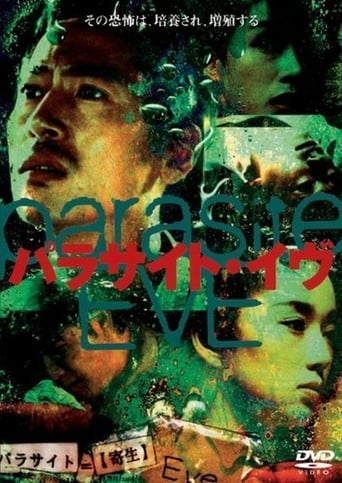
Parasite Eve (1997)
パラサイト・イヴ
Ce n'est pas un virus…c'est l'EVOLUTION!
Toshiaki Nagashima, jeune scientifique, perd sa femme dans un accident de voiture. Inconsolable, après de longues expérimentations sur les cellules mitochondriales, il réussit l’impossible… lui rendre la vie. Dans sa renaissance elle n’est plus sa douce épouse désormais, mais Eve, une entité surnaturelle dotée de pouvoirs hautement destructeurs. Et Eve n’a pas de pitié pour celui qui se met en travers de son chemin.
- Date de sortie
- 1997-02-01
- TMDB
- 5.6 / 10 (32)
- Durée
- 2 h 0 min
- Genres
- Science-Fiction, Horreur, Romance
- Réalisateur
- 落合正幸
Distribution
- 三上博史 — Toshiaki Nagashima
- 葉月里緒奈 — Kiyomi Nagashima
- Tomoko Nakajima — Sawako Asakura
- 大村彩子 — Mariko Anzai
- 稲垣吾郎 — Tatsuro Ohno
- 萬田久子 — Etsuko Odagiri
- 別所哲也 — Takatsugu Yoshizumi
- 三谷昇 — Mutsuo Ishihara
- 河原崎建三 — Shigeru Kataoka
- 深水三章
- Ikkei Watanabe
- Ren Ōsugi — Burning Man
Anecdotes
Parasite Eve is a 1997 Japanese science fiction film that was directed by Masayuki Ochiai and is based on the 1995 novel Parasite Eve by Hideaki Sena. Kiyomi, the wife of Toshiaki Nagashima, is left brain dead after a traffic accident on the day of their first wedding anniversary. Nagashima attempts to make Kiyomi live again by making a deal with a doctor who wants to harvest Kiyomi's kidneys for transplanting into a young girl in the same hospital. Nagashima agrees on the condition that he can have his wife's liver.
Production
Parasite Eve is based on the 1995 novel of the same name by Hideaki Sena. Sena had a background in pharmacology and his day job consisted of testing mitochondria with drugs to test their ability to convert fatty acids into energy. A television documentary he viewed gave him the idea of the mitochondria having a will of their own and being unwilling to continue their symbiotic relationship.
The group hired Masayuki Ochiai, who in the 1990s had made the television series Night Head for Fuji TV. The screenplay for the film was written by Ryoichi Kimizuka, who had to reorganize the non-linear approach of Sena's novel and edit the technical terms used in the novel to make it appropriate for a screenplay. Director Masayuki Ochiai stated he was "not really happy with the circumstances I was under when I had to create [Parasite Eve] ...
Lire sur Wikipédia · Texte de Wikipédia, CC BY-SA 4.0. Données de Wikidata.
Recommandés
- Lifeforce : L'Étoile du mal 1985 · ★ 6.2
- Spring 2014 · ★ 6.6
- Frequencies 2013 · ★ 6.6
- Annihilation 2018 · ★ 6.5
- Containment 2015 · ★ 5.9
- The Resurrected 1991 · ★ 6.2
- Books of Blood 2020 · ★ 6.2
- L'Homme invisible 1933 · ★ 7.5
- Pandorum 2009 · ★ 6.6
- L'Invasion des profanateurs 1978 · ★ 7.2
- The Thing 1982 · ★ 8.1
- Alien : Covenant 2017 · ★ 6.2