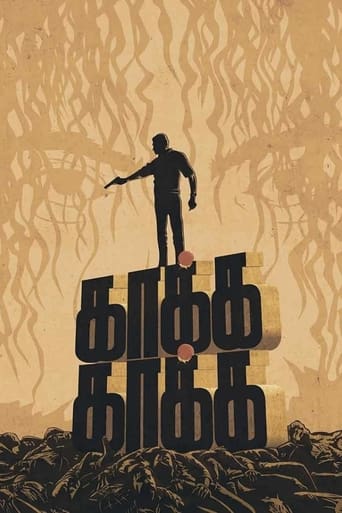
Kaakha Kaakha (2003)
காக்க காக்க
An episode in a Police officer’s life
After a police team kills his brother, a drug-dealing gangster vows to kill the entire team and their respective families.
- Date of release
- 2003-08-01
- TMDB
- 7.4 / 10 (40)
- Runtime
- 2h 31m
- Genres
- Crime, Thriller, Action
- Director
- Gautham Vasudev Menon
Casting
- Suriya — Anbuchelvan
- Jyothika — Maya Anbuchelvan
- Jeevan — Pandian
- Daniel Balaji — Shrikanth
- Devadarshini — Swathi
- Yog Jappie — Sethu
- Rajan — Ilamaran
- Gautham Vasudev Menon — Vasudeva Nair
- Ramya Krishnan — Special Appearance in "Thoodhu Varumaa" Song
- R. D. Rajasekhar — Special Appearance in "Oru Ooril" Song
- Vivek Anand — Arul
Interesting facts
Kaakha Kaakha is a 2003 Indian Tamil-language action thriller film written and directed by Gautham Vasudev Menon and produced by Kalaipuli S. Thanu. The film stars Suriya, Jyothika and Jeevan, with Daniel Balaji, Vivek Anand, Devadarshini, Sethu Rajan and Yog Japee in supporting roles. It follows a unit of police officers whose lives are threatened by a gangster whose brother they had previously killed.
Production
Gautham Vasudev Menon revealed that he was inspired to make Kaakha Kaakha after reading articles about encounter specialists. The film was initially titled Paathi (transl. Half), and then Kalam (transl. Field) before the team opted for Kaakha Kaakha, a line from Kanda Shasti Kavasam, a devotional song. Many producers refused to finance the film as they could not agree on the budget fixed by Menon; it was Kalaipuli S. Thanu who finally did so.
Jyothika was cast as the lead actress even before the lead actor had been finalised. Menon approached R. Madhavan for that role, but the actor felt he could not convincingly play an encounter specialist. Ajith Kumar and Vikram were also approached, but were reluctant to play a police officer at the time. Vijay declined as he wanted a complete script, whereas Menon decided to finalise the climax only during filming.
Menon did a rehearsal of the script with the actors, a costume trial with Jyothika and then enrolled Suriya in a commando training school before beginning production, which he described as a "very planned shoot". To prepare for the role, Suriya met two actual police officers Vijayakumar and Shailendra Babu who discussed their encounter experiences.
Anthony was initially hired to edit only the song "Ennai Konjam" for the film's audio launch. After being impressed with his work, Menon made him the film's main editor. It was also Anthony's idea to begin the film in a nonlinear manner; the scene of the lead character being shot was originally intended as "pre-climax" before it became the opening scene.
Read on Wikipedia · Text from Wikipedia, CC BY-SA 4.0. Data from Wikidata.
Recommended
- The Seven-Ups 1973 · ★ 6.3
- Por Thozhil 2023 · ★ 7.3
- Overdrive 2017 · ★ 6.1
- Kaithi 2019 · ★ 7.6
- Chekka Chivantha Vaanam 2018 · ★ 6.5
- Yennai Arindhaal 2015 · ★ 6.9
- Thick as Thieves 2009 · ★ 6.0
- The Organization 1971 · ★ 6.3
- The Glass Key 1942 · ★ 6.7
- The Mirror Crack'd 1980 · ★ 6.1
- Gotcha! 1985 · ★ 6.0
- The 355 2022 · ★ 6.0