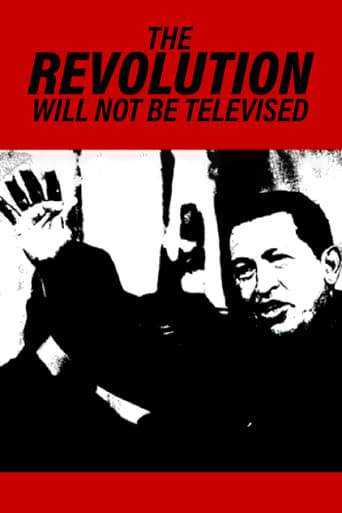
The Revolution Will Not Be Televised (2003)
La revolución no será televisada
Hugo Chavez was a colourful, unpredictable folk hero who was beloved by his nation’s working class. He was elected president of Venezuela in 1998, and proved to be a tough, quixotic opponent to the power structure that wanted to depose him. When he was forcibly removed from office on 11 April 2002, two independent filmmakers were inside the presidential palace.
- Date of release
- 2003-03-07
- TMDB
- 7.7 / 10 (59)
- Runtime
- 1h 14m
- Genres
- Documentary
- Director
- Kim Bartley, Donnacha O'Briain
Casting
Interesting facts
The Revolution Will Not Be Televised, also known as Chávez: Inside the Coup, is a 2003 Irish documentary film. It focuses on events in Venezuela leading up to and during the April 2002 coup d'état attempt, which saw President Hugo Chávez removed from office for two days. With particular emphasis on the role played by Venezuela's private media, the film examines several key incidents: the protest march and subsequent violence that provided the impetus for Chávez's ousting; the opposition's formation of an interim government headed by business leader Pedro Carmona; and the Carmona administration's collapse, which paved the way for Chávez's return.
Production
In December 1999, independent Irish filmmaker Kim Bartley visited Venezuela as part of Concern Worldwide's emergency response team, to document the aftermath of the 1999 Vargas mudslides that had devastated much of Vargas State in the north of the country.
The project was at this point named Aló Presidente, a working title taken from Chávez's weekly television and radio program. BSÉ set about exploring avenues of funding; the organization persuaded Bartley and Ó Briain to make a short pilot to show to potential investors, but refused the filmmakers' application for a €60,000 grant towards their €131,000 production budget.
In 2000, Bartley and Ó Briain had been promised "exclusive access" to Chávez by the government's Minister of Communications. They arrived in Venezuela in September 2001. While filming the pilot they met the president, after which they reconsidered their approach. Bartley explained, "We had ...
Although ensconced with Chávez and his entourage, Bartley and Ó Briain felt a disconnect from the events of the outside world. During a "chaotic" road-trip with Chávez, they "knew something was coming", and divined that Chávez's trip was intended to bolster his support and "get people used to being on the streets". Chávez had recently "upped the ante" with the introduction of the Land Law.
Using two digital video (DV) cameras, Bartley and Ó Briain shot over 200 hours of material on 300 DV tapes. They intended that editing take ten weeks; instead, it took six months. Rod Stoneman, BSÉ's CEO at the time, described the amount of footage compared to the film's final length as "exceptional". The 200:1 ratio was far above the norm for most documentaries, which usually have a ratio of 10:1 or 15:1.
Read on Wikipedia · Text from Wikipedia, CC BY-SA 4.0. Data from Wikidata.
Recommended
- Lewis Capaldi: How I'm Feeling Now 2023 · ★ 7.5
- Fuck 2006 · ★ 6.4
- Tupac: Resurrection 2003 · ★ 7.9
- Naqoyqatsi 2002 · ★ 6.2
- Audrey 2020 · ★ 7.1
- Diego Maradona 2019 · ★ 7.4
- Beyoncé: Life Is But a Dream 2013 · ★ 7.7
- Cuba and the Cameraman 2017 · ★ 7.5
- Who Are You, Charlie Brown? 2021 · ★ 6.9
- South of the Border 2009 · ★ 6.1
- The Class of ‘92 2013 · ★ 7.1
- As I Was Moving Ahead Occasionally I Saw Brief Glimpses of Beauty 2000 · ★ 7.8