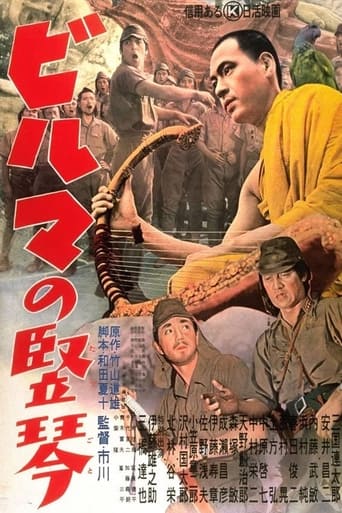
ビルマの竪琴 (1956)
In Burma during the closing days of WWII, a Japanese soldier separated from his unit disguises himself as a Buddhist monk to escape imprisonment as a POW.
Distribuție
- 三国連太郎 — Captain Inouye
- 安井昌二 — Mizushima
- 浜村純 — Ito
- 内藤武敏 — Kobayashi
- 春日俊二 — Maki
- 西村晃 — Baba
- Keishichi Nakahara — Takagi
- 伊藤利昭 — Hashimoto
- Hiroshi Tsuchikata — Okada
- 青木富夫 — Oyama
- Nobuteru Hanamura — Nakamura
- 峰三平 — Abe
Curiozități
- Bazat pe: The Burmese Harp
- Premii: 0 · Nominalizări: 2
The Burmese Harp is a 1956 Japanese drama film directed by Kon Ichikawa. Based on a children's novel of the same name written by Michio Takeyama, it tells the story of Japanese soldiers who fought in the Burma Campaign during World War II. A member of the group goes missing after the war, and the soldiers hope to uncover whether their friend survived, and if he is the same person as a Buddhist monk they see playing a harp. The film was among the first to show the losses of the war from a Japanese soldier's perspective.
Production
Michio Takeyama's novel The Burmese Harp was popular, and director Kon Ichikawa was intrigued by the narrative, but was more interested in transforming the fairy tale tone to a realistic film, and secured Takeyama's permission. Ichikawa likened his desire to make the film to "a call from the heavens".
Ichikawa met with Takeyama to discuss the story, and was surprised when Takeyama revealed he had never been to Burma, having fought in China during the war. Takeyama explained he planned to write about China, but the music he referenced in his story was not commonly found there. For a screenplay, Ichikawa turned to his wife Natto Wada, who wrote it alone and at a fast pace, but based on her husband's concepts.
Ichikawa hoped to make the film in color, but color cameras were too big, and thus costly, to be moved to Burma. Much of the film was shot in Yasui, Hakone and the Izu Peninsula in Japan.
Ichikawa rigorously followed his storyboards in shooting the film. Ichikawa also told Shoji Yasui to lose weight to portray the underfed character. The harp featured in the film is a prop, rather than a true instrument, with the song used in the film being "Home! Sweet Home!", adapted in Japan as "Hanyo no yado".
Citește pe Wikipedia · Text din Wikipedia, CC BY-SA 4.0. Date din Wikidata.
Recomandate
- Ningen no jôken II 1959 · ★ 8.2
- Ningen no jôken III 1961 · ★ 8.4
- Ultimul samurai 2003 · ★ 7.6
- Scrisori din Iwo Jima 2006 · ★ 7.5
- Steaguri pline de glorie 2006 · ★ 6.9
- împărat 2012 · ★ 6.2
- Ningen no jôken I 1959 · ★ 8.2
- Fără armă în linia întâi 2016 · ★ 8.2
- Podul de pe râul Kwai 1957 · ★ 7.8
- Play Dirty 1969 · ★ 6.3
- Prizioner de război 2025 · ★ 7.1
- The Steel Helmet 1951 · ★ 7.0