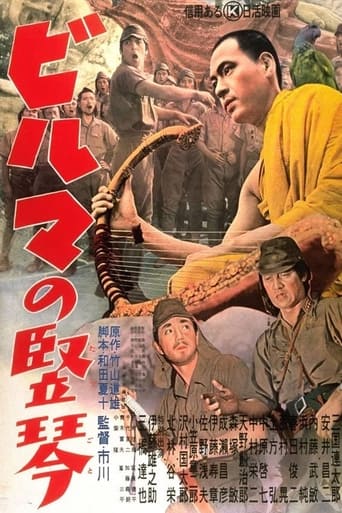
缅甸的竖琴 (1956)
ビルマの竪琴
1945年7月,东南亚的战事接近尾声,一队日本士兵行进在撤往泰国的途中。上等兵水岛(三国连太郎 饰)在音乐学院出身的队长指挥下,用自学来的竖琴鼓舞士气,抚慰战士忧伤的思绪,后更以音乐为媒介,同接受他们投降的英国士兵达成了心灵上的沟通。水岛接到任务,去劝降一队负隅顽抗的日本士兵,然而那些战士拒绝接受天皇的命令,最终全部战死,侥幸存活的水岛被一名缅甸老僧所救,他偷走了对方的僧衣,在前往战俘营的路上掩埋日军尸体,到达战俘营的水岛目睹英国人为战友举行的葬礼,若有所悟,于是赶回来路,去埋葬那些因为自己畏惧而弃之不顾的同胞遗骸。水岛的战友们相方设法打探他的下落,最后被水岛告知,自己还有没完成的责任…… 本片获1956年《电影旬报》年度十佳第五位、威尼斯电影节圣乔治奖。
演员阵容
- 三国连太郎 — Captain Inouye
- 安井昌二 — Mizushima
- 滨村纯 — Ito
- 内藤武敏 — Kobayashi
- 春日俊二 — Maki
- 西村晃 — Baba
- Keishichi Nakahara — Takagi
- 伊藤利昭 — Hashimoto
- Hiroshi Tsuchikata — Okada
- 青木富夫 — Oyama
- Nobuteru Hanamura — Nakamura
- 峰三平 — Abe
趣闻
- 改编自:緬甸豎琴
- 获奖:0 · 提名:2
The Burmese Harp is a 1956 Japanese drama film directed by Kon Ichikawa. Based on a children's novel of the same name written by Michio Takeyama, it tells the story of Japanese soldiers who fought in the Burma Campaign during World War II. A member of the group goes missing after the war, and the soldiers hope to uncover whether their friend survived, and if he is the same person as a Buddhist monk they see playing a harp. The film was among the first to show the losses of the war from a Japanese soldier's perspective.
Production
Michio Takeyama's novel The Burmese Harp was popular, and director Kon Ichikawa was intrigued by the narrative, but was more interested in transforming the fairy tale tone to a realistic film, and secured Takeyama's permission. Ichikawa likened his desire to make the film to "a call from the heavens".
Ichikawa met with Takeyama to discuss the story, and was surprised when Takeyama revealed he had never been to Burma, having fought in China during the war. Takeyama explained he planned to write about China, but the music he referenced in his story was not commonly found there. For a screenplay, Ichikawa turned to his wife Natto Wada, who wrote it alone and at a fast pace, but based on her husband's concepts.
Ichikawa hoped to make the film in color, but color cameras were too big, and thus costly, to be moved to Burma. Much of the film was shot in Yasui, Hakone and the Izu Peninsula in Japan.
Ichikawa rigorously followed his storyboards in shooting the film. Ichikawa also told Shoji Yasui to lose weight to portray the underfed character. The harp featured in the film is a prop, rather than a true instrument, with the song used in the film being "Home! Sweet Home!", adapted in Japan as "Hanyo no yado".
在维基百科阅读更多 · 文本来自维基百科,CC BY-SA 4.0。数据来自 Wikidata。
推荐
- 人间的条件(III-IV) 1959 · ★ 8.2
- 人间的条件(V-VI) 1961 · ★ 8.4
- 最后的武士 2003 · ★ 7.6
- 硫磺岛的来信 2006 · ★ 7.5
- 父辈的旗帜 2006 · ★ 6.9
- 人间的条件(I-II) 1959 · ★ 8.2
- 血战钢锯岭 2016 · ★ 8.2
- 天皇 2012 · ★ 6.2
- 亡命七金刚 1969 · ★ 6.3
- 桂河大桥 1957 · ★ 7.8
- 铁拳怒潮 2025 · ★ 7.1
- 明情 1957 · ★ 6.9