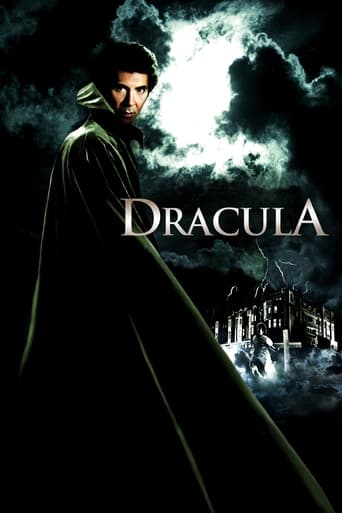
Dracula (1979)
Throughout history he has filled the hearts of men with terror, and the hearts of women with desire.
In 1913, charming, seductive, and sinister Count Dracula travels to England seeking an immortal bride.
- Date of release
- 1979-07-20
- TMDB
- 6.4 / 10 (305)
- Runtime
- 1h 49m
- Genres
- Romance, Drama, Fantasy, Horror
- Director
- John Badham
Casting
- Frank Langella — Count Dracula
- Laurence Olivier — Prof. Abraham Van Helsing
- Donald Pleasence — Dr. Jack Seward
- Kate Nelligan — Lucy Seward
- Trevor Eve — Jonathan Harker
- Jan Francis — Mina Van Helsing
- Janine Duvitski — Annie
- Tony Haygarth — Milo Renfield
- Teddy Turner — Swales
- Sylvester McCoy — Walter
- Kristine Howarth — Mrs. Galloway
- Joe Belcher — Tom Hindley
Interesting facts
- Box office: $31.2M
- Budget: $12.2M
- Earned 2.6× its budget
- Based on: Dracula and Dracula
Dracula is a 1979 gothic horror film directed by John Badham. The film stars Frank Langella in the title role as well as Laurence Olivier, Donald Pleasence and Kate Nelligan.
Production
Like Universal's earlier 1931 version starring Bela Lugosi, the screenplay for this adaptation of Bram Stoker's novel Dracula is based on the stage adaptation by Hamilton Deane and John L. Balderston, which ran on Broadway and also starred Langella in a performance for which he was nominated for the Tony Award for Best Actor in a Play at the 32nd Tony Awards.
The film was shot on location in England, at Shepperton Studios and Black Park, Buckinghamshire. Locations in Cornwall doubled for the majority of the exterior Whitby scenes; Tintagel for Dr. Jack Seward (Donald Pleasence)'s asylum, and St Michael's Mount for Carfax Abbey. The Castle Dracula was a glass matte painted by Albert Whitlock. Gilbert Taylor was the cinematographer, and the original music score was contributed by John Williams.
According to Frank Langella, Count Dracula was "a dominant, aggressive force. He must have Miss Lucy or he dies. He wants what he wants and he doesn't analyze it. Dracula as a character is very erotic. ... A woman can be totally passive with Dracula: 'he made me drink, I couldn't help it.' ... Dracula seems to represent a kind of doorway to sexual abandonment not possible with a mere mortal. Besides, he's offering immortality.
Langella wanted to explore sides of the character which were not shown before: "I decided he was a highly vulnerable and erotic man, not cool and detached and with no sense of humour or humanity. I didn't want him to appear stilted, stentorian or authoritarian as he's often presented. I wanted to show a man who, while evil, was lonely and could fall in love".
Langella held this view many years after the release of the movie. In his 2017 interview during Sitges Film Festival he said that he "saw a gentleman in [Dracula], while the bad guys were the ones who wanted to destroy him, and we see that today in many instances: ignorance leads to the desire to destroy different people, there is the suffering of homosexuals, or women." Langella remembers that the beginning of shooting was very disorganized.
Read on Wikipedia · Text from Wikipedia, CC BY-SA 4.0. Data from Wikidata.
Recommended
- Dracula 1974 · ★ 6.2
- Nosferatu 2024 · ★ 6.7
- Bram Stoker's Dracula 1992 · ★ 7.4
- The Last Voyage of the Demeter 2023 · ★ 6.7
- Mary Shelley's Frankenstein 1994 · ★ 6.4
- Interview with the Vampire 1994 · ★ 7.4
- Gabriel's Inferno: Part II 2020 · ★ 8.3
- Love Me Love Me 2026 · ★ 6.1
- Bones and All 2022 · ★ 7.0
- Fifty Shades Freed 2018 · ★ 6.7
- Lady Chatterley's Lover 2015 · ★ 6.3
- The Transfiguration 2016 · ★ 6.0