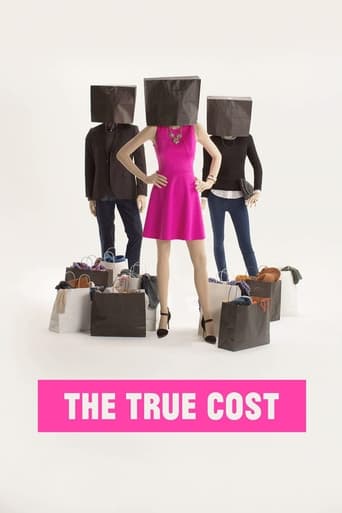
The True Cost (2015)
La industria textil fue uno de los motores de la Revolución Industrial del siglo XIX. Muchos de los trabajadores que contribuyeron a impulsarla con su mano de obra fueron las víctimas de condiciones laborales infrahumanas que ahora nos podrían parecer que son cosa del pasado, pero que por desgracia continúan siendo muy actuales. Y así nos lo quiere recordar The True Cost, un documental que nos alerta sobre la situación del sector textil y para cuya elaboración se ha buscado financiación en Kickstarter. Un total de 903 patrocinadores han contribuido para lograr recaudar 76.546$.
- Fecha de estreno
- 2015-05-29
- TMDB
- 7.5 / 10 (247)
- Duración
- 1 h 32 min
- Géneros
- Documental, Drama
- Director
- Andrew Morgan
Reparto
- Vandana Shiva — Self
- Stella McCartney — Self
- Stephen Colbert — Self
- John Oliver — Self
- Richard D. Wolff — Self
- Mark Crispin Miller — Self
Curiosidades
The True Cost is a 2015 documentary film directed by Andrew Morgan that focuses on fast fashion. It discusses several aspects of the garment industry from production—mainly exploring the life of low-wage workers in developing countries—to its after-effects such as river and soil pollution, pesticide contamination, disease and death. Using an approach that looks at environmental, social and psychological aspects, it also examines consumerism and mass media, ultimately linking them to global capitalism.
Production
The True Cost was produced by Morgan's Untold Creative in association with Life is My Movie Entertainment. The documentary's budget of US$500,000 was obtained through individual investors and Kickstarter, with Kickstarter crowd funders contributing US$76,546. Morgan refused to accept money from companies, non-governmental organizations, and foundations to keep the project "autonomous".
With no knowledge of the fashion industry, Morgan decided to make a film on the topic after being shocked by the news of the collapse of Rana Plaza. After spending several days getting information, and discovering the industry's human rights violations and "staggering environmental impacts", he was sure he had to make the film.
Regarding the ultimate objectives behind the making of the film, Morgan said he was not trying to blame just a single company nor the fast fashion industry as "it did not invent a very irresponsible way of manufacturing, it did not invent overmarketing the consumption of things." The director said the film was intended to be a caution on the "incessant consumption of mediocre stuff" and an incentive to view shopping as something more than a hobby…
Morgan said his main hope for the film was that it would spark a debate on the topic and make people "more mindful and choose things that support life and not take it away." Morgan thought he had included a good number of counter-examples of how people can make a difference, so the film does not simply show "the destructive ways this industry operates but also the opportunity to reinvent it" through "small choices [that] actually impact those [bi…
Leer en Wikipedia · Texto de Wikipedia, CC BY-SA 4.0. Datos de Wikidata.
Recomendadas
- Generación Ostentación 2018 · ★ 6.4
- La doctrina del shock 2009 · ★ 7.1
- Collapse 2009 · ★ 7.2
- Una tóxica historia de amor 2026 · ★ 6.5
- Todo lo que respira 2022 · ★ 6.9
- Fiasco total: American Apparel, la secta de la moda 2025 · ★ 6.2
- McQueen 2018 · ★ 7.4
- Matar a un tigre 2023 · ★ 7.6
- Fuck 2006 · ★ 6.4
- Voyeur 2017 · ★ 5.9
- City of Ghosts 2017 · ★ 7.2
- Mi mama Jayne: una película de Mariska Hargitay 2025 · ★ 8.0