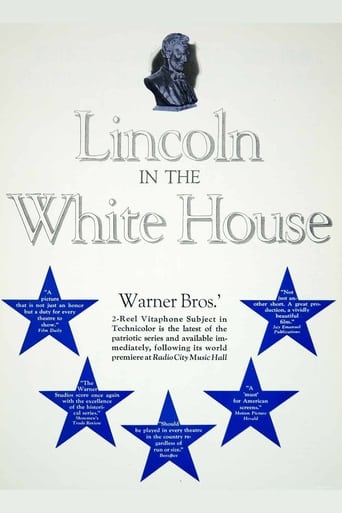
Lincoln in the White House (1939)
This short chronicles Abraham Lincoln's presidency from his inauguration through delivery of the Gettysburg Address.
- Date of release
- 1939-02-11
- TMDB
- 7.0 / 10 (2)
- Runtime
- 21m
- Genres
- Drama, History
- Director
- William C. McGann
Casting
- Frank McGlynn Sr. — Abraham Lincoln
- Dickie Moore — Tad Lincoln
- John Harron — John Hay
- Raymond Brown — Secretary of War Edwin M. Stanton
- Erville Alderson — Secretary of State William H. Seward
- Sibyl Harris — Mrs. Scott
- Nana Bryant — Mary Todd Lincoln (uncredited)
- Earl Dwire — (uncredited)
- Gordon Hart — Edward Everett (uncredited)
- Edward LeSaint — Doctor (uncredited)
- Ian Wolfe — Cabinet Member (uncredited)
Interesting facts
Lincoln in the White House is a 1939 American biographical short or historical "special" about United States President Abraham Lincoln, highlighting events during his first term of office, from his inaugural speech in 1861 to his delivery of the Gettysburg Address in 1863. Produced by Warner Bros. and directed by William C. McGann, the 21-minute Technicolor film stars Frank McGlynn Sr., a veteran actor who since 1915 had specialized in impersonating Lincoln on both stage and screen.
Production
This short is one production in a series of Technicolor two-reel historical "specials" released by Warner Bros. between 1936 and 1940. Four other such color shorts on American history were released by the studio in 1939 after Lincoln in the White House. Their subjects include the Sons of Liberty, the Monroe Doctrine, the Bill of Rights, and Andrew Jackson (under the title Old Hickory).
Costuming is one of the short's "ultra" production values that critics compliment in their 1939 reviews. Milo Anderson, a costumer for Warner Bros. since 1933, was responsible for the wardrobes in Lincoln in the White House. His work on this project is just one of at least 42 films he "attired" for Warner Bros. between 1937 and the latter months of 1939.
Filming the color short was essentially divided into two distinct parts: Wilfrid M. Cline served as chief cinematographer and Natalie Kalmus served as director of Technicolor, a color process that required special patented cameras that studios had to rent from the Technicolor Company. Those rentals also required that a representative from the company's "Advisory Service" be on site to oversee every production's color "palette".
Read on Wikipedia · Text from Wikipedia, CC BY-SA 4.0. Data from Wikidata.
Recommended
- All the Way 2016 · ★ 6.7
- Radium Girls 2020 · ★ 6.6
- Lincoln 2012 · ★ 6.8
- Oranges and Sunshine 2010 · ★ 6.9
- The Better Angels 2014 · ★ 6.3
- The Current War 2018 · ★ 6.7
- Salt of the Earth 1954 · ★ 7.0
- The Special Relationship 2010 · ★ 6.4
- Munich - The Edge of War 2021 · ★ 6.9
- Richard Jewell 2019 · ★ 7.4
- Honeydripper 2007 · ★ 5.9
- Suffragette 2015 · ★ 7.2