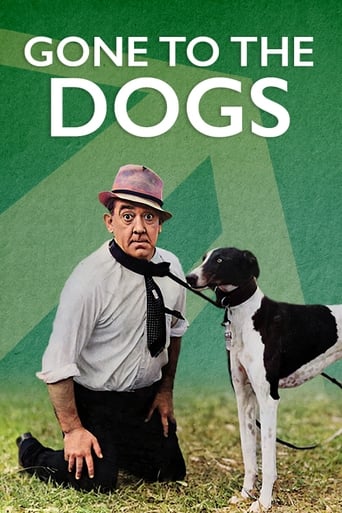
Gone to the Dogs (1939)
George is a disaster-prone zoo attendant who accidentally discovers a substance that accelerates motion, enabling his greyhound to run faster. This attracts the interest of a gang of criminals, who kidnap George's dog and plan to substitute their own in an important dog race. George and his friends defeat the crooks and their dog wins the race.
- Date of release
- 1939-08-18
- TMDB
- 6.8 / 10 (4)
- Runtime
- 1h 23m
- Genres
- Music, Comedy
- Director
- Ken G. Hall
Casting
- George Wallace — George
- Lois Green — Jean McAllister
- John Dobbie — Henry Applegate
- John Fleeting — Jimmy Alderson
- Ron Whelan — Willard
- Alec Kellaway — Mad Jack
Interesting facts
Gone to the Dogs is a 1939 musical comedy vehicle starring George Wallace. It was the second of two films he made for director Ken G. Hall, the first being Let George Do It (1938).
Production
George Wallace signed with Cinesound in February 1937. Stuart F. Doyle announced that Gone to the Dogs would be his first movie for the company but he ended up making Let George Do It first.
As with all Cinesound comedies in the late 30s, uncredited work on the script was performed by Hall, Jim Bancks and Bill Maloney. Frank Coffey was Cinesound's in house story editor. The story followed a formula developed in Wallace's Ticket in Tatts: "George is given a simple labourer's job... Quite innocently is fired... He then becomes involved in a simple wish-fulfilment device...
Filming started in January 1939 and was completed by May.
Wallace's female co-star was Lois Green, an actor with extensive stage experience with J. C. Williamson Ltd, who left Australia after filming to go work in London. The romantic male lead was an unknown amateur actor called John Fleeting, who later appeared for Hall in Come Up Smiling (1939).
The supporting cast also included John Dobbie, Wallace's long-time stooge on stage, and Howard Craven, a former publicity writer for MGM in Sydney who had gone into acting. Versatile character actor Lou Vernon was cast as the foreign-accented villain. Hughie the dog, who played George's "greyhound", was selected over 100 other applicants. Extras were drawn from Cinesound's Talent School.
Read on Wikipedia · Text from Wikipedia, CC BY-SA 4.0. Data from Wikidata.
Recommended
- Fun with Dick and Jane 1977 · ★ 6.6
- One Night at McCool's 2001 · ★ 5.9
- Louis C.K.: Ridiculous 2026 · ★ 6.1
- Much Ado About Nothing 2013 · ★ 6.8
- Why Worry? 1923 · ★ 6.5
- Pitch Perfect 3 2017 · ★ 6.5
- The Patsy 1964 · ★ 6.2
- Thunderstruck 2012 · ★ 6.2
- Adam Sandler: Love You 2024 · ★ 6.2
- Sneakerella 2022 · ★ 5.9
- Louis C.K.: Oh My God 2013 · ★ 7.5
- Chris Rock: Kill the Messenger 2008 · ★ 7.6