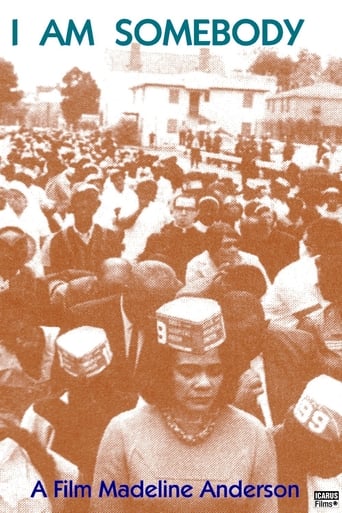
I Am Somebody (1970)
Madeline Anderson’s documentary brings viewers to the front lines of the civil rights movement during the 1969 Charleston hospital workers’ strike, when 400 poorly paid Black women went on strike to demand union recognition and a wage increase, only to find themselves in confrontation with the National Guard and the state government. Anderson personally participated in the strike, along with such notable figures as Coretta Scott King, Ralph Abernathy and Andrew Young, all affiliated with Martin Luther King’s Southern Christian Leadership Conference. Anderson’s film shows the courage and resiliency of the strikers and the support they received from the local black community. It is an essential filmed record of this important moment in the history of civil and women’s rights. The film is also notable as arguably the first televised documentary on civil rights directed by a woman of color, solidifying its place in American film history.
- Data di uscita
- 1970-01-01
- TMDB
- 6.8 / 10 (17)
- Durata
- 30 min
- Generi
- Documentario
- Regista
- Madeline Anderson
Cast
- Ralph Abernathy — Self
- Coretta Scott King — Self
- Andrew Young — Self
- Claire Brown — Self - Narrator
Curiosità
I Am Somebody is a 1970 short political documentary by Madeline Anderson about black hospital workers on strike in Charleston, South Carolina. This was the first half-hour documentary film by an African-American woman in the film industry union. This film is one of the first to link black women and the fight for civil rights.
Production
Anderson was commissioned to create a documentary about the strike by the Hospital Workers Union Local 1199. She used archival footage and interviews with strikes and city officials. Of the commission, Anderson recalls:
They were looking for a filmmaker because they wanted to make a film about the strike. Someone had recommended me, and so, would I be interested? Yeah! I had already done so much research, and I knew what was available in the libraries. I was so overjoyed to do it. I would have done it for nothing, but this was the first time that I had a proper budget. They gave me money, time, everything that I needed to make this film.
Anderson shared an interest in fighting for equity: "I knew that the obstacles that were before me were based on gender, race and politics...I tried to make a film that reflected my experience through their eyes." The film captures the events through a feminist's lens.
Leggi su Wikipedia · Testo da Wikipedia, CC BY-SA 4.0. Dati da Wikidata.
Consigliati
- Feminists: Ritratti di un'epoca 2018 · ★ 7.5
- Miss Representation 2011 · ★ 6.9
- This Changes Everything 2019 · ★ 6.2
- The Red Pill 2016 · ★ 7.5
- I Am Ali 2014 · ★ 6.7
- Cuore di un cane 2015 · ★ 6.5
- She's Beautiful When She's Angry 2014 · ★ 7.4
- Beyoncé: Life Is But a Dream 2013 · ★ 7.7
- In the Realms of the Unreal 2004 · ★ 7.2
- Jane Fonda in Five Acts 2018 · ★ 7.1
- Cameraperson 2016 · ★ 6.7
- The War Room 1993 · ★ 6.8