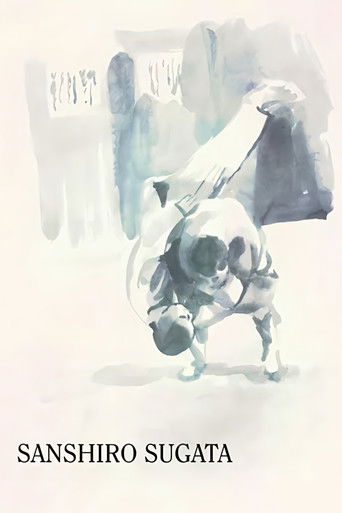
Sanshiro Sugata (1943)
姿三四郎
A hotheaded youth in 1880s Meiji Japan apprentices to judo master Shōgorō Yano, trading brute jujutsu bravado for discipline and humility. As Sanshirō matures, he proves judo’s spirit against old-guard challengers—including a deadly duel—while falling for his vanquished opponent’s daughter. Based on the novel by Tsuneo Tomita, son of Tomita Tsunejirō, the earliest disciple of judo.
- Date of release
- 1943-03-25
- TMDB
- 6.5 / 10 (150)
- Runtime
- 1h 37m
- Genres
- Drama
- Director
- Akira Kurosawa
- Collection
- Sanshiro Sugata Collection
Casting
- Denjirō Ōkōchi — Shogoro Yano
- Susumu Fujita — Sanshiro Sugata
- Yukiko Todoroki — Sayo Murai
- Ryūnosuke Tsukigata — Gennosuke Higaki
- Takashi Shimura — Hansuke Murai, Sayo's father
- Ranko Hanai — Osumi Kodana
- Sugisaku Aoyama — Tsunetami Iimura
- Ichirō Sugai — Police Chief Mishima
- Yoshio Kosugi — Master Saburo Kodama
- Kokuten Kōdō — Buddhist Priest
- Michisaburō Segawa — Wada
- Akitake Kōno — Yoshima Dan
Interesting facts
Sanshiro Sugata is a 1943 Japanese martial arts drama film written and directed by Akira Kurosawa, his feature directorial debut. It follows the story of the title character, played by Susumu Fujita, a talented though willful youth who learns discipline and martial prowess through his study of judo. The film is based on the 1942 novel by Tsuneo Tomita, which is a roman à clef of prominent judoka Shirō Saigō and the Kodokan–Totsuka rivalry.
Production
Following five years of second unit director work on films such as Uma and Roppa's Honeymoon, Akira Kurosawa was finally given the go-ahead to direct his first film, even though he himself claimed that, in films like Uma, "I had been so much in charge of production I had felt like the director".
According to Japanese cinema scholar Donald Richie, the reason Kurosawa was allowed to direct the film was because he had had two film scripts printed, including one of which had won the education minister's prize. However, his work was too far away from the government requirements for a wartime film.
When he went to the board of censors (which he likened to being on trial), the film passed on the basis of recommendation by Yasujiro Ozu, who called it an important artistic achievement despite other voices claiming it was too "British-American". After the initial release, Japanese censors reportedly trimmed the film by 17 minutes.
This film has been modified from the original version of Akira Kurosawa's debut film, which opened in 1943, without consulting the director or the production staff. 1,845 feet of footage was cut in 1944 to comply with the government's wartime entertainment policies. As much as we'd like to show the original version, we were not able to locate the cut footage. Yet we strongly believe this modified version is worthy of re-release.
In 2026, eight decades after its original release, a 4K restoration led by Toho using the existing 35mm master positive print and 35mm duplicate negative, was able to restore 12-minutes from the original cut. The new cut will have its premiere at the Cannes Classics section of the 2026 Cannes Film Festival, followed by theatrical re-releases in Japan and France.
Read on Wikipedia · Text from Wikipedia, CC BY-SA 4.0. Data from Wikidata.
Recommended
- Samurai Rebellion 1967 · ★ 8.2
- Kamui 2009 · ★ 6.1
- Samurai Marathon 2019 · ★ 6.0
- Rurouni Kenshin Part II: Kyoto Inferno 2014 · ★ 7.6
- 11 Rebels 2024 · ★ 6.9
- Taboo 1999 · ★ 6.6
- Chûshingura 1962 · ★ 7.1
- The Padre 2018 · ★ 5.9
- Born a Champion 2021 · ★ 6.9
- The Tale of Zatoichi 1962 · ★ 7.3
- Sanshiro Sugata, Part Two 1945 · ★ 6.0
- The Sword of Doom 1966 · ★ 7.8