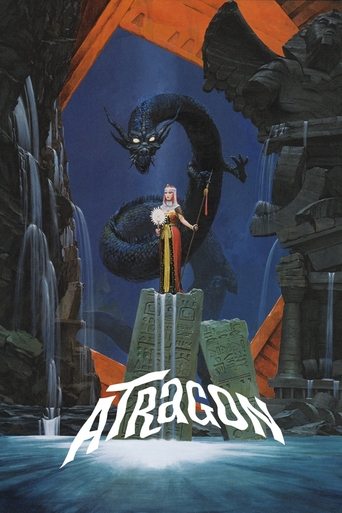
Atragon (1963)
海底軍艦
The dreaded undersea kingdom challenges the surface! The emergency dispatch of the all-purpose atomic battleship!
The legendary empire of the lost continent of Mu reappears to threaten the world with domination. While countries unite to resist, an isolated World War II Captain has created the greatest warship ever seen, and possibly the surface world's only defense.
- Date of release
- 1963-12-22
- TMDB
- 6.6 / 10 (58)
- Runtime
- 1h 36m
- Genres
- Science Fiction, Action, Adventure, Fantasy
- Director
- Ishirō Honda
Casting
- Tadao Takashima — Tasumo Hatanaka
- Yōko Fujiyama — Makoto Jinguji
- Yū Fujiki — Yoshito Nishibe
- Kenji Sahara — Uto Omino
- Ken Uehara — Admiral Kosumi
- Hiroshi Koizumi — Inspector
- Jun Tazaki — Captain Hachiro Jinguji
- Yoshibumi Tajima — Tome 'Amano' Amanoshome
- Akihiko Hirata — Mu Agent #23
- Hideyo Amamoto — High Priest of Mu
- Susumu Fujita — Defense Commander
- Minoru Takada — Government Official
Interesting facts
Atragon is a 1963 Japanese epic science fiction film directed by Ishirō Honda, with special effects by Eiji Tsuburaya. Produced and distributed by Toho, it is based on The Undersea Warship: A Fantastic Tale of Island Adventure by Shunrō Oshikawa and The Undersea Kingdom by Shigeru Komatsuzaki. The film stars Jun Tazaki, Tadao Takashima, Yōko Fujiyama, Yū Fujiki, and Ken Uehara.
Production
Atragon is loosely based on The Undersea Warship: A Fantastic Tale of Island Adventure (1899) by Shunrō Oshikawa and The Undersea Kingdom (1954-1955) by Shigeru Komatsuzaki. Komatsuzaki also served as an uncredited designer for the film, as he had with The Mysterians and Battle in Outer Space.
Shinichi Sekizawa submitted his first draft on August 10, 1963, following revisions and storyboards by Komatsuzaki.
Sekizawa thought up the character of Jinguji after reading about the Brazilian-Japanese groups Machigumi and Kachigumi, one of which felt that Japan should have won World War II. He saw this as pointless fanaticism and wanted to embody this in the admiral whose nationalism blinds him.
Instead of a dragon, Manda was envisioned as a giant rattlesnake. There is some debate as to whether Manda was always in the script (a snake monster doesn’t appear in the Undersea Kingdom) or whether the beast was added at Tomoyuki Tanaka’s insistence like he did with Maguma in Gorath (1962). Manda’s design was changed to resemble a Chinese dragon due to 1964 being the Year of the Dragon, and this was Toho’s New Year’s blockbuster.
Many of the film’s most memorable elements weren’t added until the final draft, which was finished by September 1963. This includes the Mu attack launched from Mt. Fuji, the earthquake assault on Marunochi in Tokyo, and the Gotengo’s zero cannon. Sekizawa also hoped that Captain Jinguji would be played by Toshiro Mifune, though he knew his hopes were in vain as Mifune was too expensive and tended to decline offers for giant monster films.
Read on Wikipedia · Text from Wikipedia, CC BY-SA 4.0. Data from Wikidata.
Recommended
- Message from Space 1978 · ★ 5.9
- Godzilla: Tokyo S.O.S. 2003 · ★ 7.2
- Oblivion 2013 · ★ 6.7
- Black Panther 2018 · ★ 7.4
- Death Note: L Change the WorLd 2008 · ★ 6.0
- The 5th Wave 2016 · ★ 5.9
- Babylon 5: Thirdspace 1998 · ★ 6.6
- Star Trek Beyond 2016 · ★ 6.8
- Inuyashiki 2018 · ★ 7.7
- Guardians of the Galaxy 2014 · ★ 7.9
- Rebel Moon - Part One: A Child of Fire 2023 · ★ 6.2
- Star Wars: The Rise of Skywalker 2019 · ★ 6.2