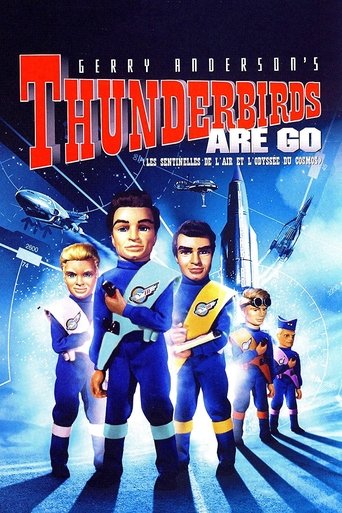
Thunderbirds Are GO (1966)
When the launch of a mission to Mars goes awry due to sabotage, International Rescue is requested to assist in the mission's second attempt.
- Data de estreia
- 1966-12-15
- TMDB
- 6.4 / 10 (60)
- Duração
- 1 h 33 min
- Géneros
- Animação, Família, Ação, Ficção científica
- Realizador
- David Lane
- Coleção
- Thunderbirds (Animation) Collection
Elenco
- Sylvia Anderson — Lady Penelope Creighton-Ward (voice)
- Ray Barrett — John Tracy / The Hood (voice)
- Alexander Davion — Space Captain Greg Martin (voice)
- Peter Dyneley — Jeff Tracy (voice)
- Christine Finn — Tin-Tin Kyrano (voice)
- David Graham — Gordon Tracy / Brains / Aloysius Parker (voice)
- Paul Maxwell — Captain Paul Travers (voice)
- Neil McCallum — Dr. Ray Pierce (voice)
- Bob Monkhouse — Space Navigator Brad Newman / Swinging Star Compere (voice)
- Shane Rimmer — Scott Tracy (voice)
- Charles Tingwell — Dr. Tony Grant / Angry Young Man / Public Relations Officer (voice)
- Jeremy Wilkin — Virgil Tracy / Space Exploration Center President (voice)
Curiosidades
- Filmado em: Portugal
Thunderbirds Are Go is a 1966 British science fiction puppet film based on Thunderbirds, a Supermarionation television series created by Gerry and Sylvia Anderson. Written by the Andersons and directed by David Lane, the film follows the spacecraft Zero-X as it carries the first human mission to Mars. When Zero-X suffers a malfunction during re-entry, it is up to life-saving organisation International Rescue, with the help of its technologically advanced Thunderbird machines, to activate the trapped crew's escape pod before the spacecraft hits the ground.
Production
When filming on Series One of Thunderbirds end in late 1965, Gerry Anderson and his financial backer, Lew Grade, agreed that a feature film would be the next logical step in expanding the Thunderbirds franchise. With United Artists (UA) contracted to distribute the film, a budget of £250,000 (about £4.23 million in 2025) was set and Anderson and his wife, Sylvia, began work on a script at their second home in Portugal.
In writing the film, the Andersons drew inspiration from the American-Soviet Space Race – in particular, the aim to land the first astronauts on the Moon – but adapted this premise for the futuristic world of Thunderbirds by switching the location to Mars. During the pre-production of their next puppet series, Captain Scarlet and the Mysterons, they wrote in an appearance of Zero-X's MEV as a link to Thunderbirds.
Frustrated with the puppets' limitations and worried that the TV series would not translate well to the big screen, Alan Pattillo declined to direct the film. The role was instead given to 24-year-old David Lane, who had directed several of the TV episodes. This made Lane the UK's youngest film director at the time.
The idea of a dream sequence at The Swinging Star was spearheaded by Sylvia, who expanded these scenes by adding in a musical interlude performed by puppet versions of Cliff Richard and The Shadows. Richard and Shadows band member Bruce Welch both owned homes in Portugal near the Andersons, and it was there that the two agreed to "appear" in the film as Supermarionation puppets.
Pre-production took three months and a 16-week shooting schedule was drawn up to coincide with the filming of Thunderbirds Series Two. Principal photography began on 3 March 1966 and ended in late June. The staff of APF, the Andersons' production company, were divided into "A" and "B" units: A to shoot the film, B the TV episodes.
Ler na Wikipédia · Texto da Wikipédia, CC BY-SA 4.0. Dados do Wikidata.
Recomendados
- Thunderbird 6 1968 · ★ 5.9
- Minions & More Volume 1 2022 · ★ 7.0
- LEGO Star Wars: The Mandalorian 2026 · ★ 6.6
- Phineas e Ferb, o Filme - Candace Contra o Universo 2020 · ★ 7.2
- Plâncton - O Filme 2025 · ★ 6.6
- Barbie em Uma Aventura nas Estrelas 2016 · ★ 6.8
- Rimas Revoltantes 2017 · ★ 6.9
- LEGO Marvel Avengers: Código Vermelho 2023 · ★ 6.5
- LEGO DC Comics Super Heróis: Aquaman - Ataque na Atlântida 2018 · ★ 6.2
- SpongeBob - Esponja em Missão 2020 · ★ 7.4
- O Feitiço 2024 · ★ 6.6
- LEGO Star Wars Contos de Arrepiar 2021 · ★ 6.8