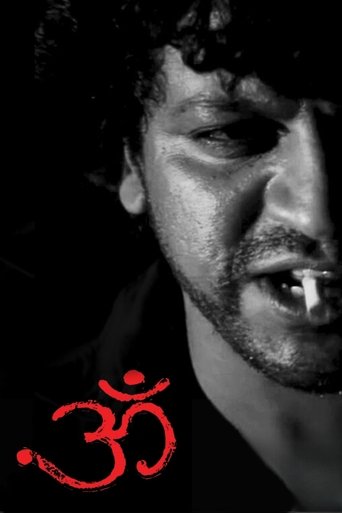
Om (1995)
ॐ
THE ORIGINAL GANGSTER
Satya, the son of a priest, leads a straightforward life until he meets the girl of his dreams. His love for her drags him into the world of crime, making him lose everyone he is close to.
Casting
- Shiva Rajkumar — Satyamurthy
- Prema — Madhuri
- Sadhu Kokila — Shankar
- Srishanthi — Shashi
- G.V. Shivanand — Madhu's Father
- Upasane Seetharam — Satya's Father
- Honnavalli Krishna — Press Photographer
Interesting facts
Om, stylized as ॐ, is a 1995 Indian Kannada-language romantic gangster drama film written and directed by Upendra. The film was produced by Parvathamma Rajkumar under the production company Sri Vajreshwari Combines. The film stars Shiva Rajkumar and Prema with Srishanthi, G. V. Shivanand, Sadhu Kokila in supporting roles with real-life gangsters - Bekkina Kannu Rajendra, Tanveer, Korangu Krishna and Jedaralli Krishnappa - portraying the role of gangsters in a small but important portion of the film.
Production
Upendra wrote a part of the story during his days in college in the late-1980s. Purushottam, a friend of Upendra, brought to him a letter written by someone that caught his attention. Drawing inspiration from it, he drafted the first part of the story, that he subsequently developed, although incompletely. He also revealed that had always wanted make a film on organized crime and mafia, based on real-life incidents.
Having given the film a working title as Satya, Upendra initially decided to cast Kumar Govind as the eponymous lead, who he had previously collaborated with, in Shhh!. However, later, eager to cast Shiva Rajkumar in the role, Upendra approached actor Honnavalli Krishna in 1994, and persuaded him to speak the matter over to Shiva's father and actor, Rajkumar. Krishna spoke to S. P.
The principal photography began on 7 December 1994 in Bangalore. On the day, Rajkumar wrote the spiritual icon "ॐ" on the film's screenplay material using kumkuma, which was later made the title design for the film. B. C. Gowrishankar who handled cinematography used a warm, yellow tone and employed filters throughout the film to diffuse the violence and the colour of the blood.
Read on Wikipedia · Text from Wikipedia, CC BY-SA 4.0. Data from Wikidata.
Recommended
- Plunder Road 1957 · ★ 6.9
- Cry of the City 1948 · ★ 6.7
- House of Bamboo 1955 · ★ 6.2
- The Quiller Memorandum 1966 · ★ 5.9
- Each Dawn I Die 1939 · ★ 6.9
- Framed 1947 · ★ 6.5
- The Asphalt Jungle 1950 · ★ 7.5
- Kid Galahad 1962 · ★ 6.2
- The Truth About Emanuel 2013 · ★ 6.0
- The Blue Gardenia 1953 · ★ 6.5
- The Brides of Fu Manchu 1966 · ★ 5.9
- The Young Savages 1961 · ★ 6.5