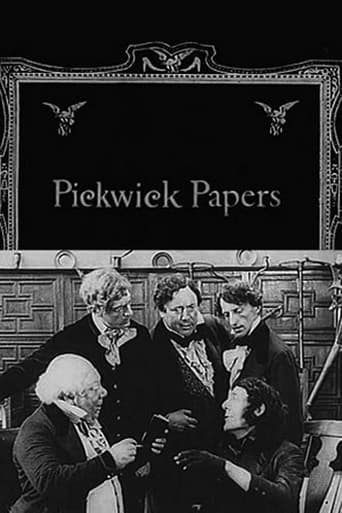
Посмертные записки Пиквикского клуба (1913)
The Pickwick Papers
Экранизация классического произведения Диккенса. Не весь роман конечно же, а один из забавных эпизодов. Мистер Пиквик любит все происходящее вокруг записывать в записную книжку. Однажды во время поездки это показалось подозрительным кэбмену, он принял его за шпиона и устроил драку. Подоспевший мистер Джингль уладил ситуацию. В честь чудесного избавления мистер Пиквик устроил попойку, на которой его друг мистер Тапмен уснул, а мистер Джингль «позаимствовал» у него фирменный «Пиквикский» фрак и отправился на бал. Там мистер Джингль приставал к чужой даме, а это вызвало недовольство её кавалера доктора Слеммера. На следующий день доктор Слеммер прислал вызов на дуэль владельцу «Пиквикского» фрака, то есть мистеру Тапмену. Мистер Тапмен был немало удивлён, однако принял вызов, думая, что он вчера, в пьяном виде, видимо, кого-то оскорбил, но не помнит этого...
- Дата выхода
- 1913-01-02
- TMDB
- 4.0 / 10 (2)
- Длительность
- 30 мин
- Жанры
- комедия
- Режиссёр
- Laurence Trimble
В ролях
- Джон Банни — Samuel Pickwick
- Arthur White — Dr. Slammer
Интересные факты
- Основан на: Посмертные записки Пиквикского клуба
The Pickwick Papers is a 1913 three-reel silent film based on the 1837 novel of the same name by Charles Dickens. The film was produced by Vitagraph Studios and features John Bunny in the title role of Samuel Pickwick.
Production
The Pickwick Papers was filmed in England rather than at the Vitagraph Company's main studio in Brooklyn, New York. Bunny, along with director Laurence Trimble and camera operator Arthur Ross, left for England on May 25, 1912. The principal goal of the trip was to film authentic scenes from Dickens's novel, with Bunny to select the actors for the other roles upon arrival in England.
Bunny had proposed filming scenes from the novel in England to Vitagraph executives around a year before production took place. As he recounted in September 1912: "The making of Pickwick has been one of my fondest dreams for several years.
Bunny's popularity was at its peak at the time he traveled to England. Regarding his time there, The Moving Picture World reported: "Whenever he appears upon the street in London he has to 'keep moving.' If he stops for any length of time he is in danger of arrest for blockading the sidewalk.
Vitagraph was committed to producing an accurate and authentic adaptation of Dickens's novel. Bunny recounted to The Moving Picture World how the Vitagraph party attempted to borrow an original two-wheeled cab from the British Museum to use in the film, but were refused by the museum curators. The group apparently made an exact replica of this vehicle, and used it frequently in the film.
Besides The Pickwick Papers, the Vitagraph party shot several one-reel films while abroad, including Bunny at Sea, filmed on board ship to England; Bunny at the Derby, filmed at Epsom Downs; Cork and Vicinity, filmed in Cork, Ireland; and The Blarney Stone, filmed at Blarney Castle. The group returned to the United States after three months abroad and incidental stops in Paris and Berlin.
Читать в Википедии · Текст из Википедии, CC BY-SA 4.0. Данные Викиданных.
Рекомендуем
- Особенности национальной охоты 1995 · ★ 6.8
- Так держать, несмотря ни на что! 1961 · ★ 6.2
- Драйв 2026 · ★ 6.9
- Особенности национальной рыбалки 1998 · ★ 6.6
- Крис Рок: Убейте вестника 2008 · ★ 7.6
- Шестерняшки 2019 · ★ 6.2
- Мистер Бонс 2001 · ★ 6.0
- Bottle Rocket 1993 · ★ 6.2
- Забавные приключения Дика и Джейн 1977 · ★ 6.6
- Тень тонкого человека 1941 · ★ 7.0
- Песня тонкого человека 1947 · ★ 6.7
- Возвращение мушкетёров 1989 · ★ 6.2