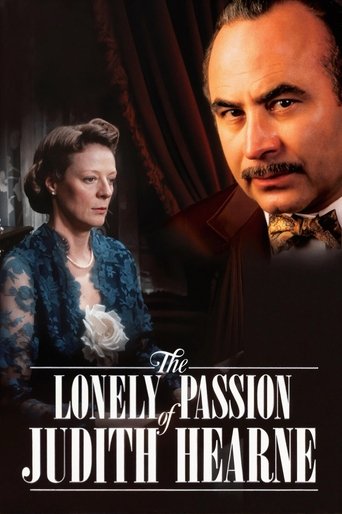
Die große Sehnsucht der Judith Hearne (1987)
The Lonely Passion of Judith Hearne
Die vereinsamte alternde Jungfer Judith Hearne hält sich im Dublin der fünfziger Jahre durch Klavierunterricht über Wasser, lebt in Pensionen und ertränkt ihren Kummer heimlich in Alkohol. Als sie den eben aus den USA zurückgekehrten Bruder ihrer Pensionswirtin kennenlernt, scheint sich ihr Schicksal zum Besseren zu wenden. Zwischen beiden entspinnt sich eine Romanze, die Judith neue Hoffnung gibt. Sie ahnt nicht, dass James glaubt, sie sei wohlhabend, und es auf ihr Geld abgesehen hat.
- Erscheinungsdatum
- 1987-12-23
- TMDB
- 6.6 / 10 (32)
- Laufzeit
- 1 Std. 56 Min.
- Genres
- Drama, Liebesfilm
- Regie
- Jack Clayton
Besetzung
- Maggie Smith — Judith Hearne
- Bob Hoskins — James Madden
- Wendy Hiller — Aunt D'Arcy
- Marie Kean — Mrs. Rice
- Ian McNeice — Bernard Rice
- Rudi Davies — Mary
- Prunella Scales — Moira O'Neill
- Áine Ní Mhuirí — Edie Marinan
- Sheila Reid — Mrs Friel
- Niall Buggy — Mr Lenehan
- Kate Binchy — Sister Ignatius
- Martina Stanley — Sister Mary-Paul
Wissenswertes
- Basiert auf: Judith Hearne
The Lonely Passion of Judith Hearne is a 1987 British drama film made by HandMade Films and United British Artists (UBA) starring Maggie Smith and Bob Hoskins. It was directed by Jack Clayton and produced by Richard Johnson and Peter Nelson, with George Harrison and Denis O'Brien as executive producers. The music score was by Georges Delerue and the cinematography by Peter Hannan.
Production
The novel was published in 1955 and there had been numerous attempts to film it over the years. John Huston wanted to film it starring Katharine Hepburn for Seven Arts Productions but was unable to raise finance.
Daniel Petrie tried to make it with Rachel Roberts and, in 1969, Irvin Kershner with Deborah Kerr. In the 1970s Jack Levin was going to produce a version with Anne Bancroft from a Brian Friel script, with Robert Shaw to co star. Then Bancroft dropped out and Vanessa Redgrave was going to star. No film eventuated. Jack Clayton greatly admired the novel and had tried to obtain the film rights himself as early as 1961 but they were never available..
In 1982 producer-writer Peter Nelson obtained the rights, and he tried to make a film with Shirley Maclaine and Mike Nichols. However Nichols wanted to relocate the story to Boston, Nelson objected and the director dropped out. Nelson then sought finance in the United Kingdom.
Finance mostly came from HandMade Films. Elton John also provided some of the budget. "I have such admiration for Handmade,” Clayton said. “Here was a subject that had been on the shelf for years because no one considered it commercial. But they went ahead.”
Nelson later said he felt his version was able to attract finance because his script emphasied the humour in the novel. "There are a lot of funny things in Judith Hearne and the script simply sharpens them," said Nelson.
Auf Wikipedia weiterlesen · Text aus Wikipedia, CC BY-SA 4.0. Daten aus Wikidata.
Empfohlen
- Brooklyn - Eine Liebe zwischen zwei Welten 2015 · ★ 7.3
- Ein verborgenes Leben - The Secret Scripture 2017 · ★ 7.2
- Zimmer mit Aussicht 1986 · ★ 6.9
- Das Lächeln der Sterne 2008 · ★ 6.3
- Finding You 2021 · ★ 6.9
- Dritte Person 2014 · ★ 5.9
- Leaving Las Vegas 1995 · ★ 7.2
- Once 2007 · ★ 7.4
- Sturmhöhe 1970 · ★ 6.4
- Du neben mir 2017 · ★ 7.2
- The Delinquent Season 2018 · ★ 6.2
- Ein ganzes halbes Jahr 2016 · ★ 7.9