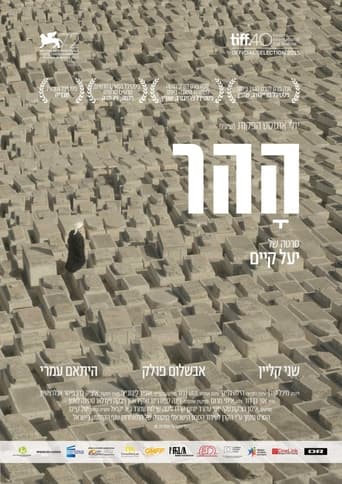
Mountain (2015)
ההר
Une jeune femme juive orthodoxe vit avec sa famille dans le cimetière juif situé sur le Mont des Oliviers à Jérusalem. Dans la journée, tandis que son mari et ses enfants sont à l’école, elle reste seule à la maison. Elle sort se promener dans le cimetière, tentant d’échapper aux interminables tâches domestiques. Une nuit, emplie de frustration, elle sort furieuse de la maison et gravit le cimetière, courant jusqu’où ses jambes voudront bien la porter. Elle est alors le témoin d’une scène de sexe troublante. Hantée par cette image, elle commence à explorer ce nouvel univers que recèle la "montagne", tout en s’efforçant de ne rien laisser transparaître pendant sa vie quotidienne. Jusqu’à ce qu’elle n’y arrive plus.
- Date de sortie
- 2015-09-12
- TMDB
- 6.5 / 10 (9)
- Durée
- 1 h 23 min
- Genres
- Drame
- Réalisateur
- Yaelle Kayam
Distribution
- Shani Klein — Zvia
- Avshalom Pollak — Reuven
- Hitham Omari — Abed
- אלי כהן — Meir
- Miki Marmur — Ronit
- Orli Perl — Miri
Anecdotes
Mountain is a 2015 drama film directed by Yaelle Kayam. The world premiere took place as part of the "New Horizons" competition at the Venice Film Festival, and the film was also screened at the 2015 Toronto International Film Festival. Additionally, it was featured at the "New Directors, New Films" festival at the Museum of Modern Art (MoMA) in New York. The film won the Jury Prize at the San Francisco Film Festival and First Prize at the Fribourg Film Festival in Switzerland. At Fribourg, Kayam also received the Don Quixote Prize for Breakthrough Female Directors. She was nominated for the Best Director award by the European Union.
Production
Director Yaelle Kayam drew inspiration for Mountain from the Mount of Olives: "For many years, I wanted to make a film about the Mount of Olives. The site exudes tremendous power and spoke to me deeply. It holds countless stories, hopes, dreams, and narratives. It’s the oldest active Jewish cemetery in the world."
During one visit, while standing by the grave of poet Zelda overlooking the Temple Mount, Kayam imagined a woman in her kitchen, staring at a pile of dishes in the sink while gazing out the window at the Temple Mount—viewing it as a promise of redemption. This image deeply moved her and inspired her to begin writing the script.
To prepare for the film, Kayam visited the Mount of Olives repeatedly, sometimes dressed in secular clothing and at other times in religious attire, immersing herself in the environment and observing its visitors. She also explored biblical, Talmudic, and Christian texts related to the site and attended Talmud study classes to deepen her understanding of redemption themes.
The film is the first Israeli-Danish co-production, created by Israeli production company July August Productions and Danish production company Windeløv/Lassen. Vibeke Windeløv, one of the Danish producers, previously collaborated with Lars von Trier on films like Dancer in the Dark and Dogville. Post-production was completed in Copenhagen, Denmark.
Kayam drew visual inspiration from the paintings of Artemisia Gentileschi, particularly her depictions of strong women like Judith beheading Holofernes. These influences are evident in the protagonist’s drastic actions at the film’s conclusion and in the interior compositions of the home, crafted with the cinematographer Itai Marom, art designer Neta Dror, and costume designer Hila Galik.
Lire sur Wikipédia · Texte de Wikipédia, CC BY-SA 4.0. Données de Wikidata.
Recommandés
- Lucky Them 2013 · ★ 6.0
- L'Affaire Cate McCall 2013 · ★ 6.4
- Strange Weather 2016 · ★ 5.9
- Holy Lands 2019 · ★ 6.1
- La fille du livre 2015 · ★ 5.8
- Hounddog 2008 · ★ 6.5
- Bastard Out of Carolina 1996 · ★ 7.1
- The Safety of Objects 2002 · ★ 6.5
- La vérité sur Emanuel 2013 · ★ 6.0
- Liaisons interdites 2012 · ★ 6.3
- Call Me Crazy: A Five Film 2013 · ★ 7.0
- Tempête de sable 2016 · ★ 6.0